

Weight loss without dieting works by building five habits around portions, protein, sleep, walking and weekly tracking, so your body slowly burns more calories than you eat while your regular home food stays on the plate. At SBM, we build these habits one at a time and hold each one for months, because the weight comes down as a result of habits that last.
- Weight loss without dieting works when five habits around portions, protein, sleep, walking and weekly tracking create a small, steady gap between the calories you eat and the calories you burn.
- In a randomised trial of 200 adults with excess weight, about three quarters of the lost weight returned within roughly three years, whether the loss was fast or slow.
- A University College London study found that a new habit takes 66 days on average to become automatic, with individual timelines from 18 to 254 days.
- At SBM, we build the five habits one at a time, trim the largest portion slightly and read progress as a weekly average.
Most advice on losing weight was written for people who weigh their food and eat from a plate. Indian meals arrive differently: a steel katori of dal, a roti passed across the table by someone who loves you, a second helping offered before you have finished the first. Weight loss without dieting fits this reality because it works with the food your family already cooks.
If you have followed a strict plan before, you know how it ends. The first two weeks feel manageable, a wedding or Diwali arrives, the plan breaks and the weight returns along with the guilt. That pattern is common and says nothing about your character.
By the end of this article, you will know how habit-based weight loss works, how long habits take to settle, the five habits to build one step at a time and the mistakes that stall progress. At SBM, we believe the fastest way to lose weight is to do it slowly and the sections ahead show what that looks like on an ordinary weekday.
1. Weight Loss Without Dieting Starts With Habits You Can Repeat on a Busy Weekday
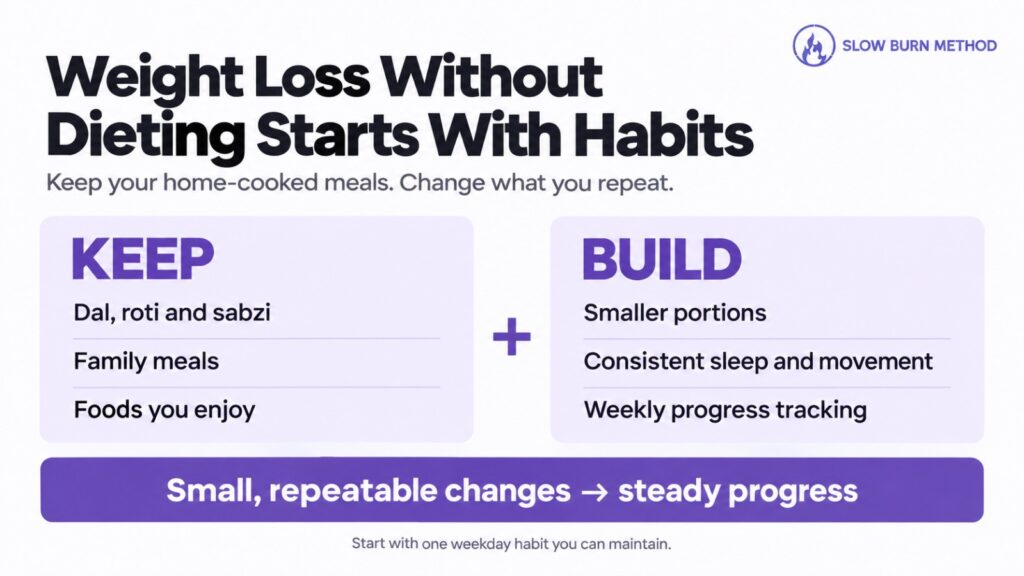
Weight loss starts with a handful of daily habits that fit around your office hours, your commute and your family’s meals and your regular food stays on the plate. When habits shift how much you eat, how well you sleep and how much you move, the calories you take in settle slightly below the calories you burn and the body responds over weeks. Stated differently, the gap is small enough that hunger and mood stay steady, which is what makes it possible to hold for a year.
The evidence for building habits first is sobering. In a randomised trial of 200 adults with excess weight, those who reached their target on either a 12-week rapid programme or a 36-week gradual programme regained about three quarters of the lost weight within roughly three years. At SBM, we read plainly: programmes end, habits keep going and that is why habits have to come first. If you have regained weight three times after a strict plan, the plan was never the solution and our post on why your last plan failed and why that was never your fault explains the rest.
Write down the three weekday moments that decide your eating, such as the tiffin, the 4 pm snack and the late dinner. Your first habit will target exactly one of those moments.
2. A Pace of About 0.5 to 1 kg per Week Is the Pace We Coach at SBM
A pace of about 0.5 to 1 kg per week (1 to 2 pounds) is the pace we coach at SBM and it matches the range the CDC describes as gradual and steady. The CDC’s guidance holds that people who lose weight at this pace are more successful at keeping it off. The trial above found that the speed of weight loss did not change the proportion of weight regained, which is why our case for going slowly is a practical one. At SBM, we’ve found that a pace this size asks for habits you can hold, such as one fewer roti at dinner or a walk after meals and those habits keep working after week twelve.
Stated differently, the pace protects the habits and the habits protect the progress. Any plan that promises a fixed number on the scale in a fixed number of days offers a certainty that nobody can deliver. Pick one habit this week that you could still repeat six months from now.
3. Habits Take Roughly Two to Three Months to Become Automatic
A new habit takes about 66 days on average to become automatic and individual timelines in the University College London study ranged from 18 to 254 days. The 96 volunteers chose a daily health behaviour, such as eating a piece of fruit with lunch and rated how automatic it felt over 12 weeks. Simpler behaviours settled sooner, more demanding ones such as exercise took longer and about half of the group had not reached a clear habit by day 84. Slow progress in the first two months is the normal pattern and our guide to building a habit that actually sticks shows how to plan for it.
Here is what that pattern looks like in a real week.
If you have started and stopped before, you may want structure around these first months. Take Control, our 20-week flagship programme, was designed for long-term habit change in people who have tried before and found that nothing lasted. See how Take Control works on the SBM website and decide whether that structure suits you.
4. How to Start Weight Loss Without Dieting in Five Steps
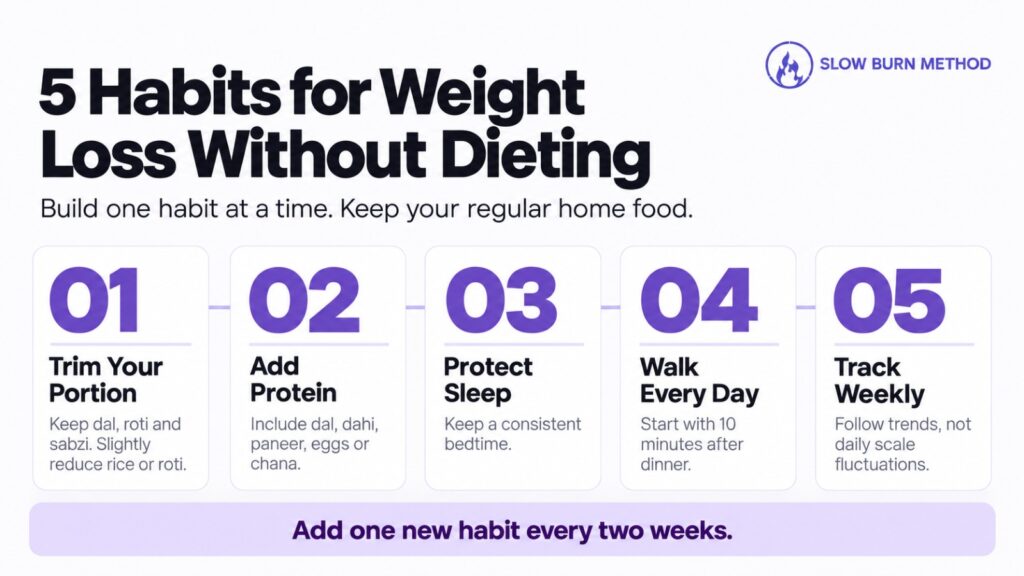
You start weight loss without dieting by building five habits one at a time: trim your largest portion, anchor each meal with protein, fix your sleep window, walk at a fixed time and track your progress weekly. Add one new step every two weeks and keep the earlier steps running while they settle.
Step 1: Keep your regular food and trim the largest item
Eat the dal, roti, sabzi and rice your family cooks and start with the biggest item on your plate, which in most Indian homes is rice or roti. Trim it slightly, for example one roti fewer at dinner or one ladle less of rice and leave everything else exactly as it is. Measure it with your own katori so the portion stays consistent.
Step 2: Anchor every meal with a protein source
India’s national nutrition guidelines from ICMR-NIN set the protein requirement for a healthy adult at 0.83 g per kg of body weight per day, which works out to about 54 g for a 65 kg adult. Dal, dahi, paneer, eggs and chana all count and our guide to protein in Indian meals shows how to spread them across the day. Put the protein source on your plate first and add roti or rice around it.
Step 3: Fix your sleep window
In experiments where people slept between 3.5 and 5.5 hours, they ate about 385 kcal more the following day, according to a meta-analysis of 11 studies and the researchers say this may add to weight gain over time. Late dinners and long commutes squeeze sleep in Indian cities, so at SBM we treat a fixed lights-out time as a weight loss habit. Choose your lights-out time tonight and work backwards from it.
t SBM, we call walking the most underrated weight loss tool because almost everyone can start it today with no equipment and no gym. Ten minutes after dinner counts and a terrace, a corridor or a phone call on the move all work if you feel uneasy about walking outdoors with the neighbours watching. Attach the walk to something you already do, such as clearing the dishes after dinner.
Step 5: Track the habit daily and the scale weekly
Tick off each habit on a calendar and weigh yourself at the same time on the same days, because water, salt and a late dinner all move the scale within a day. At SBM, we treat a flat weekly average over three weeks as a real plateau and only then do we change one habit; our post on why the weighing scale is a bad judge of progress explains why. Change one habit after three flat weeks and keep the rest as they are.
5. Common Mistakes That Stall Progress and How to Fix Them
The mistakes that stall progress most often are removing roti or rice completely, skipping meals before a function, replacing home food with packaged snacks marketed for weight loss and reacting to every daily weigh-in. At SBM, we’ve found that a staple removed for the whole table becomes an argument at every meal and the argument usually ends at the second helping. Keeping the roti and trimming the portion ends the argument, because nobody at the table has to change anything. Dal, roti, sabzi and dahi are food your body knows how to use and a packaged snack adds cost without building any of the habits above.
Even when you’re choosing nutritious home-cooked meals, portion sizes and everyday eating patterns can affect your progress. If you’ve been wondering why you’re not losing weight when you’re eating healthy, this guide explains what might be getting in the way.
Skipping lunch to save room for the wedding dinner leaves you arriving hungry and eating fast, so the evening plate ends up larger than the lunch would have been. Family plates carry their own pressure, since someone always offers another roti and refusing can feel like a comment on the cook. A warm “thoda baad mein” (a little later) answers the offer while honouring the love behind it and a calm line such as “Mera plan chal raha hai” (my plan is going well) handles comments about your weight. Eat your regular lunch on the day of a function and read our guide to eating well at weddings and festivals before the next one.
6. The Fastest Way to Lose Weight Is to Do It Slowly
The fastest way to lose weight is to do it slowly and at SBM that means five habits, built one at a time and held for months until they run on their own. Regain is common after strict plans of any speed and habits are the part of the process that stays with you when a programme ends. Your dal, your roti and your family’s table can all stay exactly where they are while the habits do their quiet work.
Frequently Asked Questions
How long does it take to see progress with habit-based weight loss?
You can expect to see progress over three-week averages and each habit feels automatic after roughly two to three months. A University College London study found an average of 66 days, with individual timelines from 18 to 254 days. At SBM, we change a habit only after three flat weeks.
Can I lose weight without dieting or exercise?
Yes, you can lose weight without dieting or a formal workout. Weight comes down when you burn more calories than you eat and portion size, protein, sleep and a daily walk all shift that balance. At SBM, we add these habits one at a time so that each one has room to settle.
Can I eat roti and rice and still lose weight?
Yes, you can eat roti and rice and still lose weight. The amount on your plate and what sits beside it shape your progress. Keep both, trim the portion slightly, for example one roti fewer at dinner and add dal, dahi, paneer or eggs. The weekly average counts and a single meal barely moves it.
How much protein do I need per day in India?
India’s national guidelines from ICMR-NIN set the protein requirement for a healthy adult at 0.83 g per kg of body weight per day, which is about 54 g for a 65 kg adult. Dal, dahi, paneer, eggs and chana count toward it. Anyone with a medical condition should confirm their number with a doctor.
Why do I regain weight after strict plans?
People regain weight after strict plans because the habits that would hold it were never built. In a randomised trial, people on structured programmes, fast or gradual, regained about three quarters of the lost weight within roughly three years. At SBM, we build five habits one at a time to give the weight a stable base.