


You build a high protein Indian diet by spreading protein across your three main meals with dal, dahi, paneer, eggs and soya chunks already in your kitchen. The ICMR-NIN recommended allowance for healthy adults is 0.83 grams per kilogram of body weight per day, about 54 grams for a 65 kg adult, and about 1 gram per kilogram for cereal-based plates with lower-quality protein. The sample day below reaches roughly 78 grams from ordinary kitchen food.
- Total daily protein comes first, and spreading it across breakfast, lunch and dinner may add a benefit, with 25 to 30 grams per meal as a planning example for some adults.
- Indians eat an adequate average amount of protein at home, yet nearly half of it comes from cereals, so the gap sits in protein quality and spread.
- Dal, dahi, paneer, eggs and soya chunks can cover the ICMR-NIN allowance from a home kitchen, as the sample day shows.
- Our approach is one manageable meal-level change at a time, which keeps the plate familiar and easy to repeat.
Most advice on protein was written for people who eat grilled chicken, weigh their food and keep a shaker bottle in the bag. Indian meals do not work like that. A typical lunch is a roti or a plate of rice, a katori of dal, a spoon of sabzi, and dahi only if someone remembered to set it. That is why so many searches for a high protein Indian diet end with lists that assume a kitchen you do not have.
By the end you will know how much protein you need, where Indian meals lose it, and what one full day of home-cooked high protein Indian food looks like with the grams counted. Our approach starts with a plate you can change in five minutes at the stove, using ingredients you already have.
1. A High Protein Indian Diet Starts at 0.83 Grams per Kilogram
The ICMR-NIN recommended allowance for healthy adults is 0.83 grams of protein per kilogram of body weight per day, about 54 grams for the 65 kg reference man and 46 grams for the 55 kg reference woman. That allowance assumes good-quality protein, and the same document gives about 1 gram per kilogram for cereal-based plates with lower-quality protein, roughly 65 grams for a 65 kg adult.
These are minimum allowances for healthy adults, and people who are physically active may benefit from more. The ICMR-NIN (2024) guidelines say that for people doing resistance training, intakes above about 1.6 grams per kilogram add no further muscle gain, so it applies to people who train for muscle. Children, older adults, pregnant women and anyone with kidney disease or another medical condition should set a target with a doctor or dietitian. Multiply your weight in kilograms by 0.83 to find your minimum.
2. Indian Plates Run Short on Protein Quality and Spread
Indian meals run short on the quality and spread of protein, because the average quantity at home is already close to adequate. A 2025 CEEW analysis of household survey data found that Indians eat an average of 55.6 grams of protein a day at home, yet cereals supply nearly half of it against the 32 per cent NIN recommends, and pulses supply 11 per cent against a recommended 19 per cent. Swaminathan (2012) reported almost 60 per cent of protein coming from cereals, which are limited in the amino acid lysine and low in digestibility. ICMR-NIN’s answer is to pair cereals with pulses and milk at a ratio of about 3:1:2.5 and a bowl of dal and dahi beside the roti moves a plate in that direction.
From the plate side this is confusing: you were told dal is protein, and the number on your tracker still looks low. The tracker is usually right, because a katori made from 40 grams of dry dal gives only about 9 grams of protein. Look at your last three lunches and count how many katoris of dal, dahi or paneer shared the plate with the roti or rice.
3. Protein at Breakfast and Lunch May Matter as Much as Dinner
Total daily protein comes first, and spreading it across breakfast, lunch and dinner may add a benefit, though the evidence comes from small, short trials. In a 2015 study, Murphy (2015) followed 20 overweight or obese men, average age 66, through four weeks of calorie restriction, with resistance training added for the last two. One group ate 25 per cent of daily protein at each of four meals and the other ate 7, 17, 72 and 4 per cent. Muscle protein synthesis was higher in the evenly spread group during restriction, and with training it matched its pre-restriction level while the dinner-heavy group stayed below. Ten men per group, four weeks and a measure of how fast muscle protein is made, which differs from muscle size or strength, means the study says little about younger adults and supports no fixed per-meal rule.
Twenty-five to thirty grams per meal is a practical planning example for adults with a higher daily total. If your need is about 54 grams, three even meals come to about 18 grams each, and 25 to 30 grams per meal makes sense when your total is closer to 75 to 90 grams, as it may be for people who train or weigh more. In many Indian homes breakfast is chai with a biscuit or a paratha, so the lowest-protein meal is often the first. Begin with the meal that has the least protein today and improve that one first.
Changing one meal is simple on paper and harder to repeat through festivals, travel and busy workweeks. If you would like coaching support while you build the habit, our Take Control programme is designed for gradual, habit-led change.
4. A High Protein Indian Diet Plate Takes Three Steps
You can build a high protein Indian plate in three steps, and each one uses food already found in an Indian kitchen. Nothing here needs a new shopping list.
Step 1: Choose an anchor protein
Pick one main source for the meal, such as moong dal chillas at breakfast, dal with soya chunks at lunch, or paneer or eggs at dinner. The anchor should carry roughly 10 to 20 grams on its own.
Step 2: Add a second protein
Put dahi, a boiled egg, roasted chana or a second dal on the same plate. This brings the meal toward your own per-meal target from Section 3.
Step 3: Check the grams
Compare your plate with the table in Section 5 for one week. Stop counting once the portions feel familiar.
Give each meal about a week. Our approach is to start with the lowest-protein meal, often breakfast, and then move to lunch and dinner, and how long a change takes to feel routine differs from person to person. One change at a time is easier to repeat through Diwali or a tiring fortnight at work. Write down tomorrow’s breakfast anchor tonight.
Building a protein-rich plate is also a useful starting point if you’re trying to lose weight without exercise, because what you eat matters alongside how active you are.
5. One Full Day of High Protein Indian Meals Adds Up to About 80 Grams
One full day of home-cooked high protein Indian meals adds up to about 78 to 79 grams of protein, around 1.2 grams per kilogram for a 65 kg adult, and the cereal protein from your usual roti or rice is extra and not counted. Weights are dry unless stated, a katori of dahi means 150 grams, and a katori of dal or rajma means a bowl made from 40 grams of dry dal or rajma, because thin and thick dal in the same bowl can differ by several grams.
| Meal | What is on the plate | Working (g) | Approx. protein |
|---|---|---|---|
| Breakfast | 2 moong dal chillas (50 g dry dal), 50 g paneer filling, 1 katori dahi | 12.0 + 9.0 + 5.2 | 26 g |
| Lunch | 1 katori toor dal, soya chunk sabzi (25 g dry chunks), raita with half a katori dahi | 8.9 + 13.0 + 2.6 | 25 g |
| Dinner, option A (vegetarian) | 100 g paneer sabzi, 1 katori moong dal | 18.0 + 9.6 | 28 g |
| Dinner, option B (egg-eating) | 3 whole eggs as bhurji, 1 katori rajma | 18.8 + 9.6 | 28 g |
| Day total | Breakfast, lunch and one dinner option | about 78 g (A) or 79 g (B) |
Values are approximate, based on IFCT 2017 (National Institute of Nutrition) and USDA FoodData Central, and they vary with brand, preparation and serving size. Only one dinner option counts toward the day.
Portion size matters more than a food’s reputation. Dry moong dal holds about 24 grams of protein per 100 grams, so 50 grams gives 12 grams, while a thin dal made from 20 grams gives under 5 grams in the same katori. Cooked dal is mostly water, so 100 grams of cooked dal holds roughly a third of the protein in 100 grams dry or less, which is why the table counts dal by dry weight.
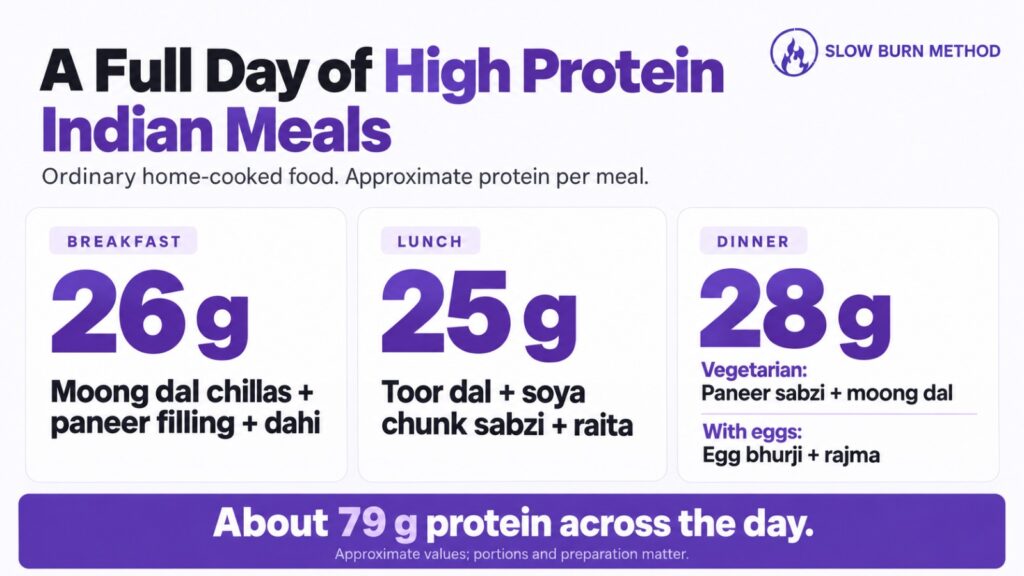
Treat the day as a template for your own requirement from Section 1. Fifty grams of paneer gives about 9 grams, which an egg and a half would match, and 15 grams of dry soya chunks (about 8 grams) can replace 25 grams if your total is lower. Add an egg or a katori of dahi at breakfast if you train or need more.Cook the day once as written, then adjust it to your own appetite and requirement.
6. Four Common Mistakes in a High Protein Indian Diet
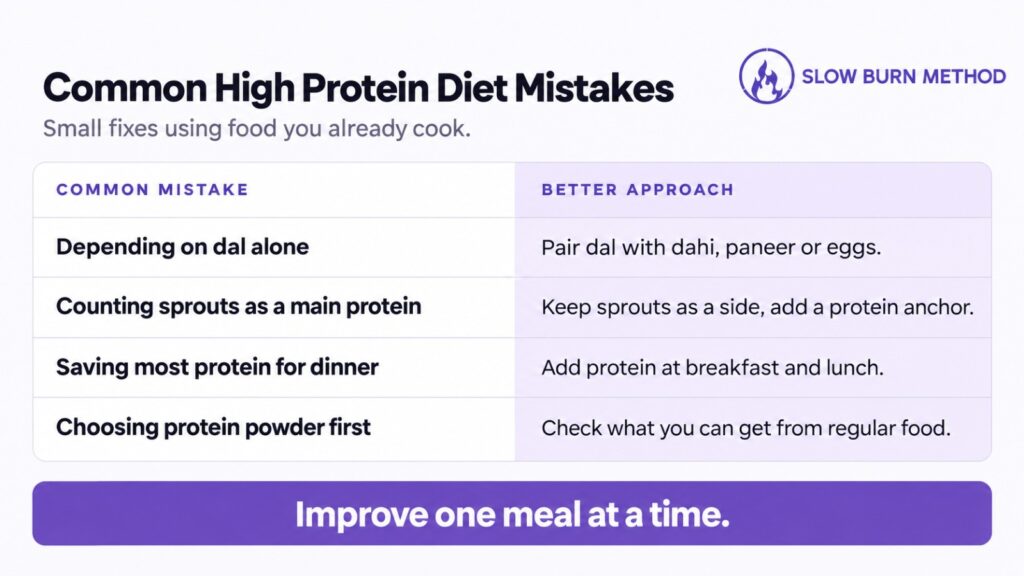
Four habits keep protein low in otherwise sensible Indian meals, and all four are easy to fix. The first is treating dal as the whole answer, since a katori made from 40 grams of dry dal gives about 9 grams and sits well short of a meal-sized portion. The second is sprouted moong, which holds only a few grams of protein per 100 grams because it is mostly water, so it works as a fibre-rich side beside paneer, dahi or an egg. The third is loading dinner, which leaves breakfast and lunch carrying very little.
The fourth is reaching for powder first. The ICMR-NIN (2024) guidelines advise against protein supplements for building muscle and say prolonged heavy use of powders or concentrates has been associated with potential problems such as bone mineral loss and kidney damage. Some clinicians feel supplements suit athletes with very high needs, so a doctor or dietitian can settle the question. A plate like the one above reaches the allowance from food, and Vegetarian protein sources for Indian meals has more variety. Pick the one mistake you recognise and fix only that this week.
7. The Slow Way to Eat More Protein Is to Raise One Meal at a Time
The sustainable way to eat more protein is to understand what your body needs and then raise one familiar meal at a time. At SBM, we build everything on one claim, that the fastest way to lose weight is to do it slowly, and protein follows the same logic. A katori of dahi added to breakfast is easy to carry through Diwali week, and a plan that changes every meal on Monday asks far more of a busy household.
Your kitchen and your family’s tastes shape how the plate looks. Dal, dahi, paneer and eggs are already bought, cooked and liked at home, so small changes in quantity and combination are a practical place to start, and your own weight and activity set the amount.
8. Questions People Ask About High Protein Indian Meals
Which Indian foods have the most protein?
Per 100 grams dry, soya chunks lead at about 52 grams, then dals and rajma at 22 to 25 grams, and paneer at about 18 grams as eaten. Serving size changes the ranking: 25 grams of dry soya chunks gives about 13 grams, 50 grams of paneer about 9 grams. Cooked dal holds about a third of its dry value.
Can I get enough protein from dal alone?
Dal alone usually falls short. A katori made from 40 grams of dry dal gives about 9 grams, so three katoris reach about 27 grams, well below the 54 grams ICMR-NIN suggests for a 65 kg adult. Dal pairs well with rice or roti for protein quality, and dahi, paneer or eggs close the gap.
Do I need protein powder for a high protein Indian diet?
Most healthy adults can meet the ICMR-NIN allowance from food, and the 2024 guidelines advise against supplements for building muscle, citing potential risks from prolonged heavy use. Some clinicians disagree for athletes with very high needs, and a doctor or dietitian can advise if you have a medical condition.
How much protein should I eat at each meal?
Start with your daily total and divide it by your number of main meals. A 65 kg adult at 0.83 grams per kilogram needs about 54 grams, or about 18 grams per meal, while a total of 75 to 90 grams gives 25 to 30 grams per meal. Improve your lowest-protein meal first.
Is sprouted moong a good protein source?
Sprouted moong holds only a few grams of protein per 100 grams because it is mostly water, and USDA lists about 2.5 grams in a cup of cooked sprouts, against about 24 grams per 100 grams for dry moong dal. It adds fibre and variety, and needs paneer, dahi or an egg beside it to carry a meal.