
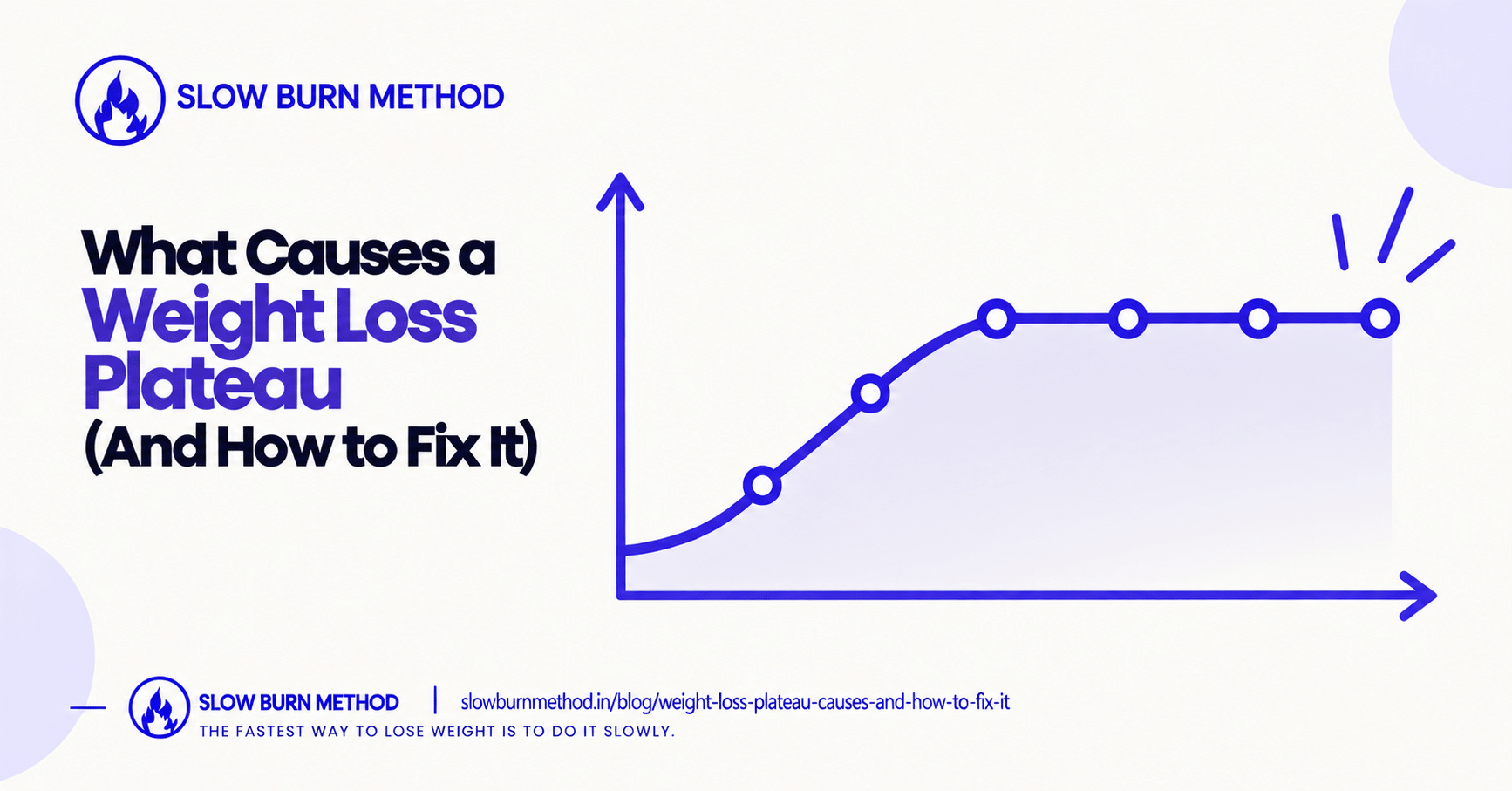

A weight loss plateau is a flat average weight over several weeks, and it usually comes from small changes adding up: lower energy needs at a lighter body weight, quieter everyday movement, drifting portions, water fluctuation and a routine that has become too strict. You fix it by confirming the trend first, then reviewing what has changed and adjusting one thing at a time. At SBM, we make that adjustment slowly, because large cuts rarely survive real life.
- A weight loss plateau is a flat three-week average, and a single flat week is normal fluctuation.
- Lower energy needs, drifting portions, reduced everyday movement and water retention are the most common contributors.
- Cutting harder makes a plateau worse because the routine becomes too strict to repeat.
- The SBM fix is to confirm the trend, review what changed, and adjust one habit at a time.
Most advice on a stalled scale tells you to eat less and train harder. That advice was written for people with no wedding season, no joint-family lunches and no evening chai with biscuits, so it rarely survives contact with an Indian household. If you have been eating well and exercising regularly and your weight loss plateau has lasted weeks, the frustration is real, and it says nothing about your character. By the end of this article, you will know how to confirm whether you are on a genuine plateau, which six factors usually sit behind it, and the five steps we use at SBM to get progress moving again.
1. A Weight Loss Plateau Is a Flat Average Over Three Weeks
A weight loss plateau is a period of several weeks in which your average weight stays flat while your routine stays the same. Body weight moves daily because of water retention, food volume, salt, digestion, sleep and hormonal fluctuations, so one unchanged reading proves nothing. At SBM, we treat a flat weekly average over three weeks as a real plateau and anything shorter as ordinary fluctuation. Waist measurements, how your clothes fit, strength and energy add useful context alongside the scale. Weigh under the same conditions each time, and judge the three-week average.
2. Your Body Needs Less Energy Than It Did at the Start
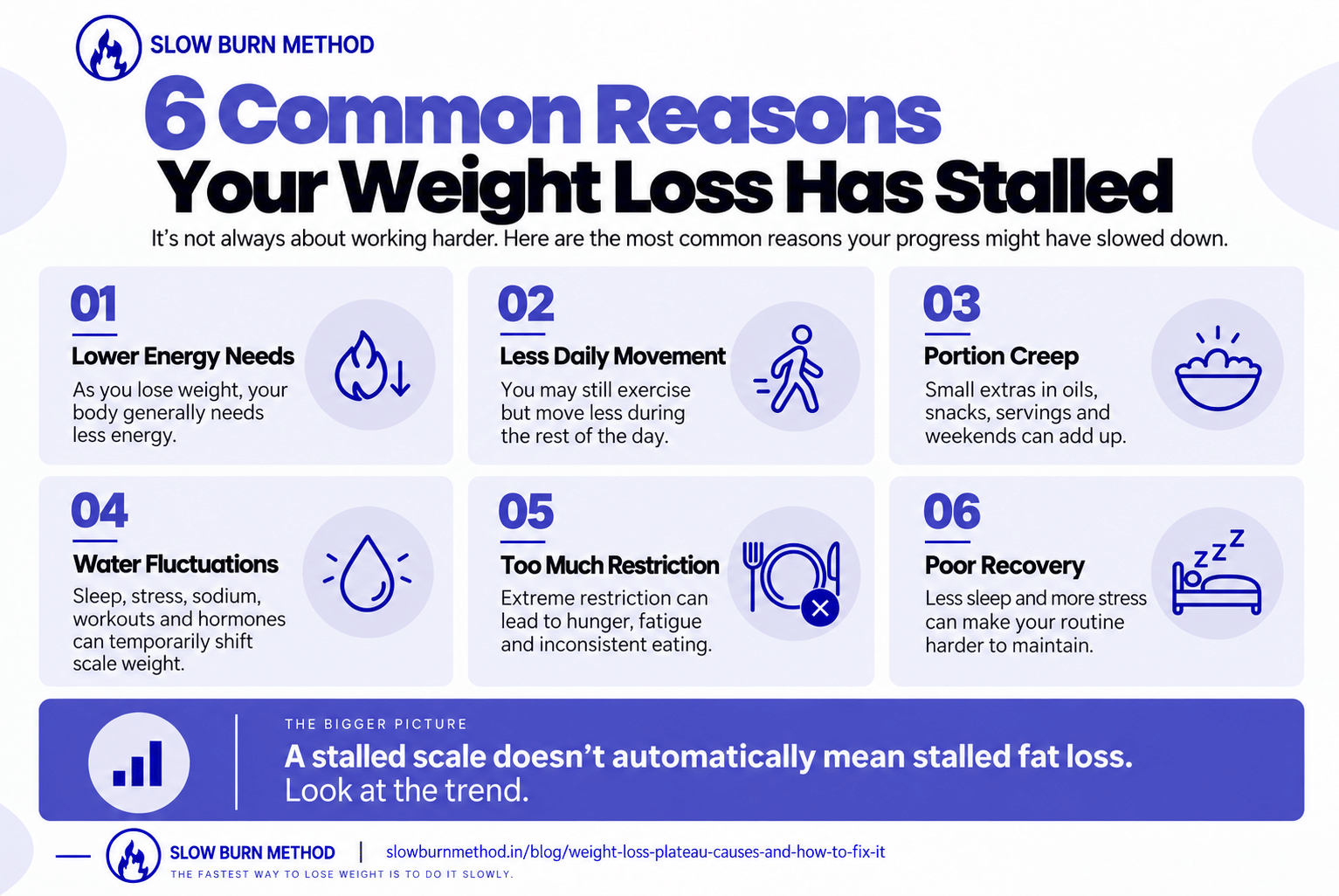
Your energy needs fall as you get lighter, and research shows the body can adapt further after weight loss. A lighter body costs less to run, so the routine that created a clear gap at the start creates a smaller one now. A systematic review by Nunes et al. (2022) pooled 33 studies with 2,528 adults and found adaptive thermogenesis in 27 of them. The same review reported large variation between studies, lower or non-significant effects in the better-designed ones, and an effect that seems to fade or disappear once weight stabilises. Stated differently, the body does adapt, but the size of the effect varies and is often modest, so blaming a broken metabolism for your plateau is usually inaccurate. Compare your current routine with the one you started with and ask whether it still fits the body you have now.
3. Everyday Movement Slips Quietly While the Workout Stays on Schedule
Everyday movement drops without a decision, and a consistent workout hides the drop. Among our students, the usual picture is someone who completes every planned session while taking fewer steps, sitting longer at work and doing less around the house. The urban Indian routine makes this easy, with long commutes, desk jobs and late dinners. Check your steps for the last two weeks and add a short walk after dinner.
4. Portions Drift Without Anyone Deciding It
Portions grow slowly, and you rarely notice because no single change looks big. It is a little more ghee on the roti, a second helping of rice, a handful of nuts while cooking, or biscuits with the evening chai. Weekends, Diwali, Navratri and wedding season shift the pattern further, and none of that is a mistake, since these occasions are part of life. The useful question is whether your current routine matches the one you followed when your weight was moving down. The Snack Guide helps with the evening hunger that often drives the drift. Write down everything you eat for three ordinary days, including the spoon of ghee and the chai biscuits, and compare it with your early weeks.
5. Water Can Hide Fat Loss for Days
Water retention can make a weight loss plateau look worse than it is, so a single high reading tells you very little. A salty meal, a change in carbohydrate intake, a harder workout, poor sleep, stress or hormonal shifts can all move water in your body for a few days. A higher number after the weekend says nothing precise about body fat. My position as a coach, and the one we hold across SBM, is that the average decides the question, and the single reading does not. Wait out the weekend, weigh on your usual morning and let the three-week average decide.
6. Cutting Harder Makes a Weight Loss Plateau Worse
Eating less and adding workouts usually extends a plateau because the routine becomes too strict to repeat. The pattern we see at SBM is consistent: progress slows, the person cuts portions sharply and adds sessions, hunger and cravings rise, and a few weeks later they swing into eating more than they intended and blame themselves. If you have regained weight after a strict phase more than once, the strictness was the problem and your character was fine. A routine has to make room for weekends, travel, family functions and busy periods, or it will not last. Loosen one rule that you break every week and keep the rest.
7. Sleep and Stress Change What You Can Sustain
Poor sleep and heavy stress make familiar habits harder to keep, and that shows up as a plateau. In our coaching experience, a demanding work period brings snacking, skipped walks and missed workouts almost every time, and the scale reflects the habits more than the stress itself. Ask yourself whether you are sleeping less, whether work has become heavier, and whether your eating or movement changed during a stressful stretch. Sometimes the most useful adjustment is to make the routine easier. Pick the one habit that has slipped during your busy period and restore it at its smallest version.
8. You Can Break a Weight Loss Plateau in Five Steps
You can respond to a weight loss plateau in five steps, taken in order. Work through them one at a time, because changing everything at once makes it impossible to know what helped.
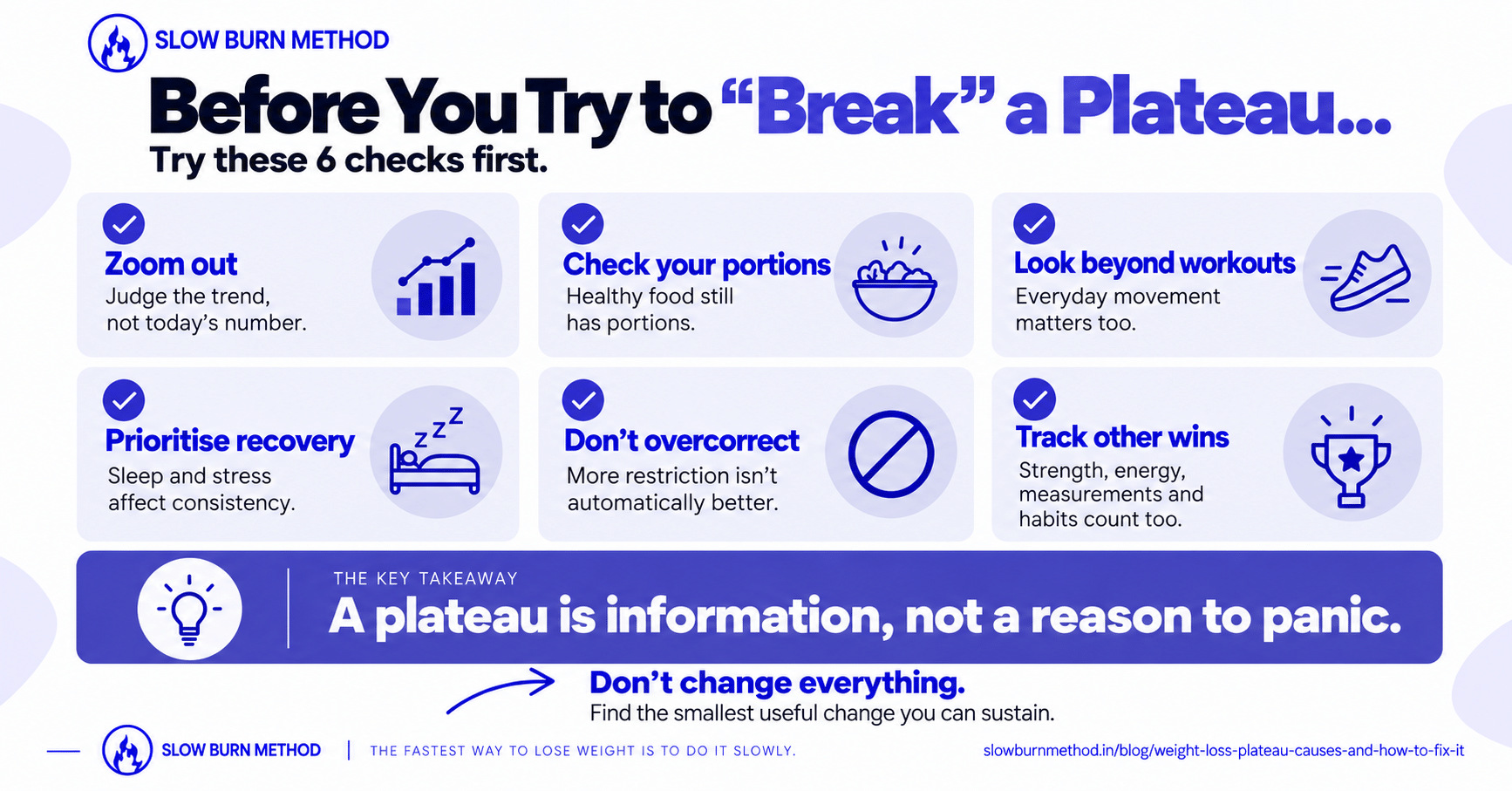
Step 1: Check the trend. Look at your weight over three weeks under consistent conditions. A meta-analysis by Madigan et al. (2015) found that adding self-weighing to a behavioural weight loss programme may improve weight loss, while evidence for self-weighing as a lone strategy was lacking. Use the scale to read the trend, and treat it as one input.
Step 2: Review what changed. Compare portions, snacks, weekends, everyday movement, workouts, sleep and stress with your early weeks. Ask also whether you are expecting the same rate of loss that you had at the start, since the first weeks are usually the fastest.
Step 3: Return to the basics. Check that your meals are satisfying, that you eat enough protein for your needs, that you move daily, that your strength training suits your fitness level and that your routine fits your actual schedule.
Step 4: Change one thing. Choose a single adjustment, such as reviewing portions, adding a daily walk, improving weekend consistency or rebuilding a sleep routine. Give it three weeks before deciding whether another change is needed.
Step 5: Measure more than weight. Track waist, strength, energy, sleep and habit consistency alongside the scale, because they move at different speeds and together they show the full picture. Start with Step 1 today and finish Steps 2 and 3 before you touch Step 4.
9. Progress Shows Up in Confidence and Consistency Before the Scale
Progress during a plateau often appears first as confidence and consistency, well before the scale admits it. Student B described her biggest win as something beyond a number: “I could really take control… of my food, my nutrition, my exercise, my strength, my mindset.” Student C said the experience made him more consistent, and in his words: “I thought it was another program, but it made me more consistent. I never thought I would stick to it.” These are personal experiences and every person’s progress looks different, but both describe what we hear from students across SBM, which is that steady habits outlast any single week’s reading. Write down one thing you do now that you could not do when you started.
10. A Plateau Sometimes Needs a Doctor, and Knowing When Matters
See a doctor if your weight changes are persistent and unexplained, or if they come with symptoms that worry you. Medical conditions, medications and hormonal changes can all affect body weight, and they need individual assessment. SBM is not a medical service, and a general article cannot diagnose these causes. Book the appointment if something feels off, and bring your three-week weight record with you.
Frequently Asked Questions About a Weight Loss Plateau
How long does a weight loss plateau last?
A weight loss plateau has no fixed duration. A flat week is normal fluctuation, but a flat three-week average is a real plateau. Review your portions, everyday movement and recovery, change one thing, and give it two to three weeks before judging the result. If nothing moves after that, speak to a doctor.
Why am I not losing weight even though I exercise?
Exercise supports health, but weight loss depends on your overall routine. Portions drift, everyday movement drops outside the workout, sleep slips and energy needs fall as you get lighter. Audit three ordinary days of food and your daily steps before adding another session, because the gap is usually there.
Should I exercise more when I hit a plateau?
Add movement only after checking your recovery. If you are tired and sleeping badly, another workout makes the routine harder to repeat. Two strength sessions and a daily walk you can sustain will do more than five sessions you abandon by week three.
Should I cut carbohydrates to break a plateau?
Cutting rice or roti is rarely the fix. Removing a food group makes the routine harder to follow at family meals and festivals. Review your portions, protein, snacks and movement first, then adjust one thing. Roti, rice and dal can stay on the plate.
Can stress cause a weight loss plateau?
Stress can stall progress by changing sleep, appetite and daily habits. In our coaching experience, people snack more, walk less and skip workouts during demanding stretches. Address those habit changes directly, and keep the routine simple until the stressful period passes.
Is a plateau a sign that my metabolism has slowed?
Energy needs fall as you get lighter, and some research finds extra adaptation after weight loss, though well-designed studies report smaller effects. Water fluctuation, portions and movement often explain a plateau just as well. Check those first before concluding your metabolism has changed.