

If you are eating healthy but not losing weight, the most likely reason is the small, recurring additions you are not counting: cooking oil, sweetened chai and coffee, sauces, and the bites you take between meals. Each one feels too small to matter, but together they can quietly cancel out the calorie deficit your meals are creating. At SBM, this is one of the first things we check, because it is usually the simplest to fix once you can see it. You do not need to eat less at your meals. You need to see what is adding up around them.
Most advice on losing weight was written for people who eat from measured containers, log every ingredient in an app, and cook for one. Indian kitchens do not work like that. You pour oil straight from the bottle. You cook for the whole family and serve yourself from shared dishes. You add sugar to three cups of chai across a working day, and you finish what is on the stove because it is there and it is good.
So when you are eating healthy but not losing weight, the standard advice is to eat less and track more. At SBM, we think that skips the more useful question: what, specifically, is adding up in your day that you are not currently counting? That question is answerable without obsessing, and answering it is usually enough.
By the end of this article you will know which additions are most worth checking in your own routine, roughly what each one costs you, and the single observation to run this week. No food scale. No logging every bite. Nothing taken off your plate that you actually enjoy. Start by reading with your own kitchen in mind, not someone else’s.
1. What hidden calories actually are
Hidden calories are not invisible or hidden on purpose; they are simply the calories that are easy to overlook because they come from additions, drinks, and in-between bites rather than from meals. When you think back over your day, you remember the plated meals. You are far less likely to remember the oil in the tadka, the sugar in each cup of chai, the handful of peanuts eaten while answering email, or the two biscuits taken between meetings.
None of those moments register as eating the way a full thali does. They still count toward your energy for the day, and because they repeat, they count every single day. Stated differently, the problem is often not what you choose at meals, it is what you forget to account for around them.
A bowl of sabzi is genuinely nutritious. The oil, sauce, or cheese used to cook it changes how much energy that bowl carries. Nutritious and energy-dense are not opposites; both can be true of the same food, and the amount is always part of the picture. For the next few days, pay attention to what happens around your meals, not just to the meals themselves.
2. Why small additions quietly stall weight loss
Small additions stall weight loss because your body weight tracks the gap between the energy you take in and the energy you use, and a steady trickle of unaccounted oil, sugar, and snacks can close that gap even when your meals are balanced. A real calorie deficit produces weight loss. Remove or shrink the deficit, and progress flattens, no matter how clean the main meals look.
The amount genuinely matters here, not just the food. A 2024 systematic review from the USDA’s Nutrition Evidence team, covering studies from 2000 to January 2024, concluded that serving larger portions increases food and energy intake in adults and older adults. That applies not only to plate size but to how much oil goes into the kadhai, how much sugar goes into the chai, and how large a “handful” of nuts actually is.
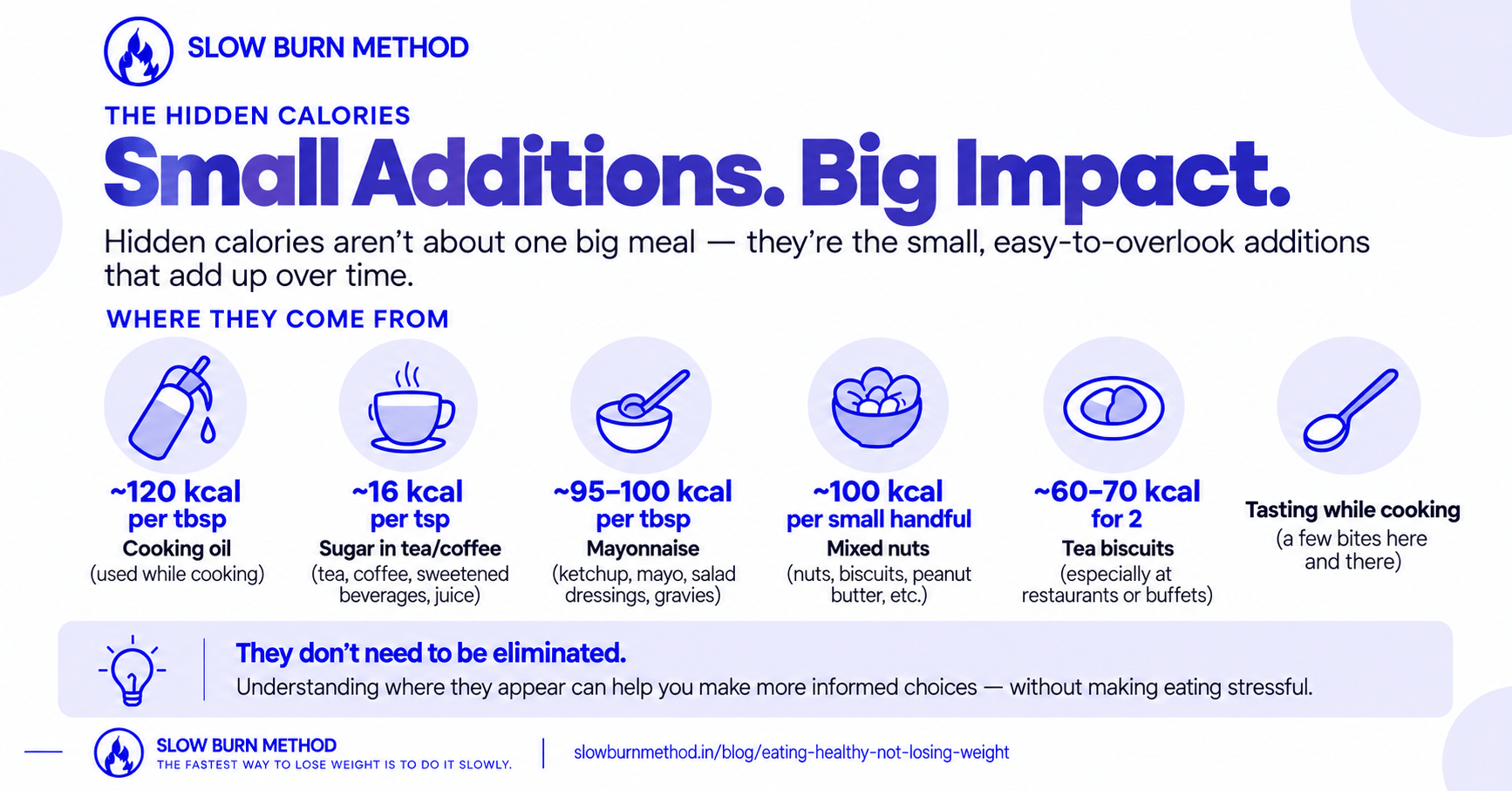
Here is roughly what the usual suspects cost. Treat these as reference estimates, not exact counts, because real values shift with brand, recipe, and how much you actually use.
| Addition | Typical amount | Approximate calories |
| Cooking oil | 1 tablespoon (about 15 ml) | ~120 kcal |
| Sugar | 1 teaspoon (about 4 g) | ~16 kcal |
| Plain tea biscuits | 2 small biscuits | ~70 kcal (larger or richer ones, 100–120+ kcal) |
| Mixed nuts | Small handful (15–20 g) | ~90–120 kcal |
| Mayonnaise | 1 tablespoon | ~90–100 kcal |
Sources: USDA FoodData Central and the Indian Food Composition Tables 2017 (IFCT 2017), National Institute of Nutrition, ICMR. IFCT 2017 puts biscuits at roughly 458 kcal per 100 g, so the calories in “two biscuits” depend heavily on their actual size and weight. For packaged foods, the nutrition label is the most reliable number you have. Before you assume your food choices need a complete overhaul, check the small additions first.
A quick note on where this goes next: if you have accepted that the gap is probably in the additions and you want a structure to build that awareness without counting grams, our 20-week Take Control programme .
3. Cooking oil and ghee are the easiest to underestimate
Cooking oil and ghee are the single easiest source to miss, because they disappear into the cooking and never feel like something you ate. Oil for sautéing, a tadka for the dal, ghee on the last roti, a little extra when the dish is for the whole family. One tablespoon of oil carries roughly 120 kcal, and “a little” is genuinely hard to judge when you are pouring from a bottle rather than a spoon.
This is not an argument to cook without oil. It is an argument to know your real number. India’s national nutrition guidelines (ICMR-NIN, 2024) recommend keeping total fat to no more than about 30% of your energy for the day, with visible fats like oil, ghee, and butter used in moderation rather than freely (ICMR-NIN Guidelines for Indians, 2024). When you are cooking for several people, the practical move is to look at the total oil that went into a dish and divide by the number of servings. For the next three days, measure the oil you actually pour and compare it against what you assumed you were using.
4. Chai, coffee, and sweetened drinks
Drinks are easy to miss because they never feel like eating, yet sweetened chai, milky coffee, packaged beverages, and juice all add to your intake across the day. Most people have several of these between morning and night without counting a single one. Three cups of chai with two spoons of sugar each is not nothing, and it repeats daily.
The research backs paying attention here. A 2023 systematic review and meta-analysis by Nguyen and colleagues found that higher consumption of sugar-sweetened beverages was linked to weight gain, while cutting them back supported weight loss (Nguyen et al., 2023, AJCN). No single cup needs to vanish from your day. For a clear picture, write down everything you drink for two or three ordinary days, including what you add to each one, and look for the pattern rather than judging any one cup.
5. Sauces, spreads, and stand-up snacks
A spoon of mayonnaise, dressing, peanut butter, or cheese spread, and the roasted nuts you eat while working, are nutritious or harmless in isolation but add up fast, because you almost never serve them as a measured portion. You eat them straight from the jar, the packet, or the pan, and the amount drifts upward without any decision being made.
Nutritious does not mean unlimited, just as higher-calorie does not mean forbidden. These foods can sit comfortably in a good week of eating; the only real question is how much and how often. If you enjoy a spread or a snack, serve yourself a portion and put the container away, which lets you notice the amount without taking the food off the menu. For practical ways to handle this between meals, our snack guide is a useful starting point.
6. The bites that never make the mental list
The hardest category to see is the one you never record at all: tasting the curry as you cook, finishing the last two bites off your child’s plate, a biscuit with chai, something grabbed from the kitchen between tasks. Each bite feels too small to matter. Repeated across a day, every day, they become a consistent part of how you eat.
Research on attention while eating supports this. A 2013 systematic review and meta-analysis by Robinson and colleagues found that eating while distracted increases how much you eat at that moment and, more strikingly, how much you eat later, while actively remembering what you have already eaten tends to reduce later intake. The fix is not willpower, it is attention. Over the next few days, simply notice when these bites happen and what you were doing, hungry, bored, cooking, stressed, or just eating on autopilot.
7. What one of our students noticed between meals
One of our students, Student A, put his stall into a single sentence: he ate limited portions at meals but snacked in between, assuming that meant he was eating less. His meals were genuinely modest. What he had not accounted for was everything happening around them, and that gap, not a lack of discipline, was what kept the scale flat.
His experience is exactly why it is worth looking past the main meals. Someone can honestly feel like they are eating less while a steady pattern of snacking runs quietly alongside. Once he could see the pattern, he could do something about it. The detail that stayed with us was not a number on a scale; it was being able to play with his one-year-old son for longer without tiring. Progress at SBM looks different for everyone, so treat his story as a prompt to find your own pattern, not a template to copy.
8. How to find your hidden calories and get weight loss moving again this week
To find your own hidden calories, pick one category and watch it for a few days, then change at most one thing, rather than overhauling everything at once. You do not need to weigh ingredients or log meals indefinitely. Run it as a short, specific experiment:
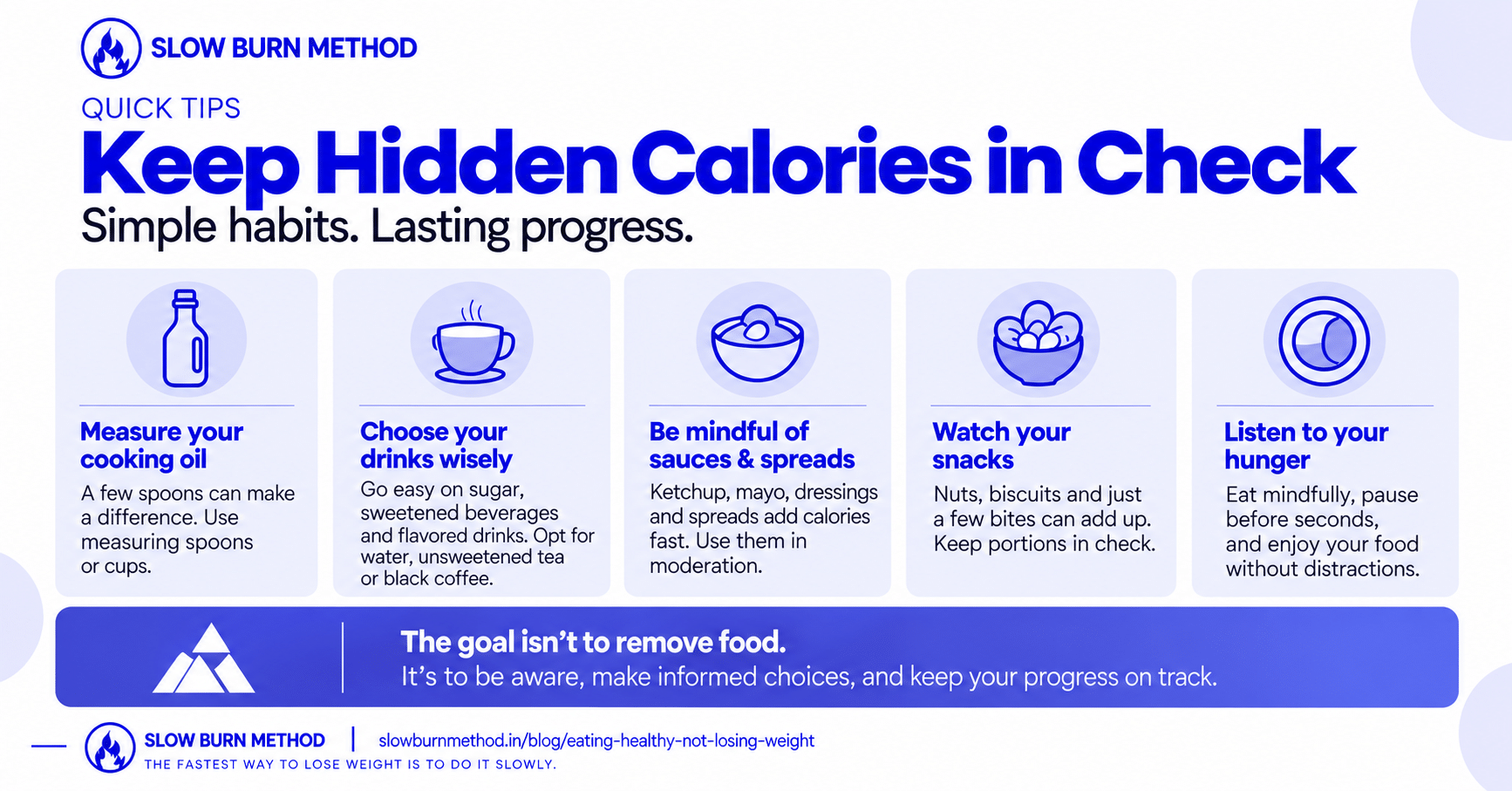
- Pick the one addition that is hardest for you to estimate right now: cooking oil, sweetened drinks, sauces and spreads, or between-meal bites.
- For three to five ordinary days, just observe it. Do not change anything yet; you are only gathering an honest picture.
- Compare what you saw against what you assumed, and name the gap out loud.
- Decide whether this is something you want to keep as it is, or whether one small, manageable adjustment would actually improve your day.
- Make that one change, and leave everything else alone until it feels automatic.
If the scale has been flat for three or more weeks and your meals already feel right, the issue may be broader than a few additions, which is worth reading about before you cut anything further, in our pieces on why the scale is a poor judge of progress and handling a plateau without panic . And if counting is the part you dread, you do not need it; our simpler way to think about calories covers how to build awareness without obsession. Choose one category today and start watching it.
Frequently Asked Questions
Why am I maintaining or gaining weight even though I eat healthy food?
Healthy food still carries energy, and most stalls come from amount rather than choice. Oil poured by eye, sugar in several cups of chai, sauces, nuts, and bites between meals add up across the day and can erase your deficit. Check those recurring additions before assuming your meals are the problem.
What is the single biggest source of hidden calories?
Cooking oil and ghee, in most Indian kitchens. One tablespoon of oil is roughly 120 kcal, and it is almost always poured rather than measured, so the real amount runs higher than people think. Sweetened drinks, sauces, and casual snacking are the next most common sources worth checking.
Can healthy foods like nuts, oil, and peanut butter cause weight gain?
Yes, if the amount is large and frequent. Nuts, seeds, oils, and nut butters are nutritious and also energy-dense, so they contribute real calories regardless of how good they are for you. The amount is always part of the picture. Serve a portion instead of eating straight from the container.
Do I need to count calories to lose weight?
No. Counting works for some people, but for most, simply noticing your recurring additions, cooking fat, drinks, sauces, and between-meal bites, is enough to find where extra energy is coming from. Awareness does the heavy lifting here, not precision. One honest week of observation usually beats an app.
How do I cut hidden calories without giving up foods I enjoy?
Start with one addition that is hard to estimate, watch it for a few days, then make a single manageable change if the amount is higher than you expected. Serve snacks and spreads as a portion rather than from the jar. You keep the foods; you just stop the amount from drifting.
How long before I see results once I fix this?
Give any change three weeks before you judge it, because daily weight swings hide the real trend. At SBM, we treat a flat weekly average over three weeks, not a few quiet days, as a genuine plateau worth investigating. Make one change, hold it steady, and read the trend, not the daily number.
Where this actually leads
The slow method has always started in the same place: see clearly before you change anything. Not stricter rules, not less food, just an honest look at what your day actually contains. Most stalls we see are not a failure of effort or the wrong food choices; they are small, repeated gaps in visibility that, once closed, finally let the work you are already doing show up.
So here is the question worth sitting with: what is the one addition in your day that you never quite account for? That is almost always the best place to start. Pick it this week and watch it. If you want that awareness built into a structure that holds through busy weeks, travel, festivals, and family meals, our 12-week Take Control programme was built around exactly these habits. See how it works and decide whether it fits the way you actually live.