

You lose weight with a thyroid condition by letting your doctor manage your levels and medication while you build four slow habits on top of that treatment, which are protein at every meal, a daily walk, a steady sleep window and a weekly weight average. Treatment usually brings modest weight loss at best, so most of the remaining progress comes from daily habits. At SBM, we’ve found that people with thyroid conditions respond to the same slow method as everyone else.
- Thyroid treatment usually brings modest weight loss: a 2013 retrospective review found that 52% of newly diagnosed patients lost weight within 24 months of starting levothyroxine, with a mean loss of 3.8 kg (8.4 pounds)
- Four habits built one at a time (protein, walking, sleep and weekly averages) move progress forward without touching your medication.
- Slow progress suits a thyroid condition, and our approach is built on behaviour change with your doctor in charge of the dose.
Most advice on how to lose weight with thyroid problems arrives as a one-line verdict and in many Indian families that verdict sounds like this: “Thyroid hai, isliye weight nahi ghatega.” If you have been told your thyroid is the reason or told to simply eat less, you have probably felt blamed and confused at the same time and that confusion is completely understandable. At SBM, we’ve found that people with a thyroid condition rarely get a clear plan and a clear plan is what changes their progress. By the end you will know what thyroid treatment can realistically do for your weight, which four habits to build one at a time and how long to give them.
1. What to Expect When You Lose Weight With Thyroid Treatment
Thyroid treatment usually brings modest weight loss and for many people it brings none. In a retrospective review of patients with newly diagnosed primary hypothyroidism, presented at the American Thyroid Association’s 2013 annual meeting, about half (52%) lost weight within 24 months of starting levothyroxine, with a mean loss of 3.8 kg (8.4 pounds) (Lee, Braverman and Pearce (2013)). A 2021 retrospective study of 346 adults with hypothyroidism reported that adequate levothyroxine treatment did not associate with weight reduction and that patients either kept the same weight or continued to gain.
The American Thyroid Association explains that most of the weight gained with an underactive thyroid is retained salt and water and that about 2.3 to 4.5 kg (5 to 10 pounds) of weight gain may be related to the thyroid depending on severity. That matches a small 2010 study which found that the weight lost after treatment came from excess body water, while fat mass stayed virtually unchanged
Stated differently, your medication clears the extra fluid and brings your body back to its baseline and the next stage of weight loss is built by what you do every day. That is hard to hear after months of waiting for the tablet to do the work and the frustration is fair. Your doctor decides your dose and the American Thyroid Association, as quoted by University of Miami Health (2018), cautions that pushing hormone levels higher is unlikely to change weight significantly. Ask your doctor when your next blood test is due and keep that appointment before you change anything else.
2. Why a Slow Pace Suits a Thyroid Condition Best
A slow pace suits a thyroid condition because your starting point can keep shifting in the early months. Your doctor may adjust your dose after blood tests. At SBM, we’ve found that quick fixes always end in regain and a thyroid condition does not change that pattern. If you have regained weight three times after crash approaches, the approach was never the solution and you can stop blaming yourself for it.
Give yourself a realistic timeline of three months for building habits, with the scale acting as a secondary signal. At SBM, we treat a flat weekly average over three weeks as a real plateau and only then do we adjust anything, as we explain in Dealing with weight loss plateaus without panic. A single heavy morning means very little and Why the weighing scale is a bad judge of progress walks through the reasons in detail. Wedding season, Diwali and Navratri will each arrive in the middle of this process and a slow plan has room for all of them. Count the habits you completed this week and let the weekly average show the rest.
3. The Four Habits That Help You Lose Weight With Thyroid Issues
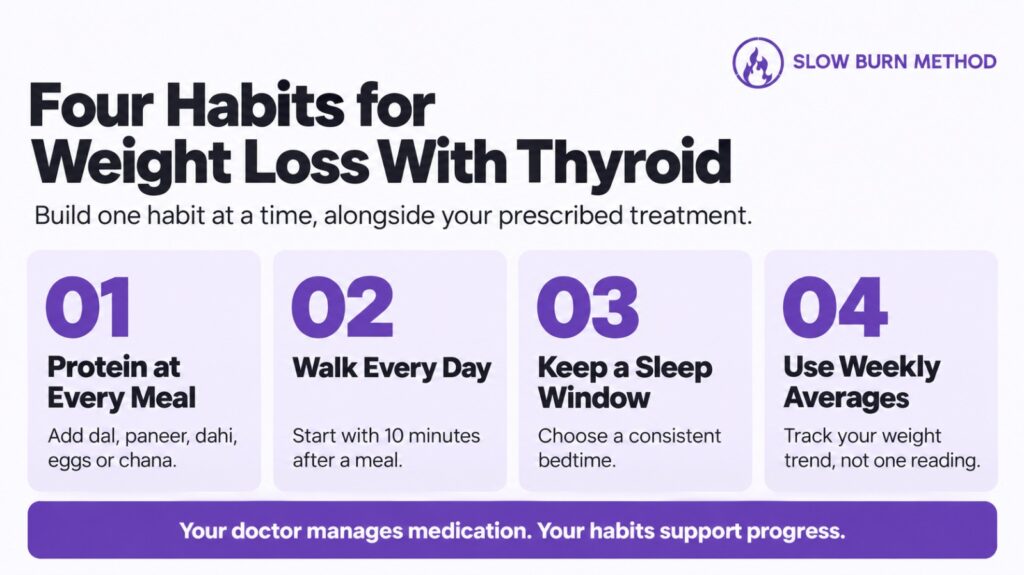
Four habits, built one at a time in a fixed order, give you a workable path to lose weight with thyroid treatment already in place. Add each new habit only when the previous one feels automatic.
Step 1: Protein at every meal
Protein at every meal means building each plate around a protein source. The ICMR-NIN Expert Group sets the recommended allowance for healthy Indian adults at 0.83 grams per kilogram of body weight per day, which works out to about 50 grams for a 60 kg adult. A katori of dal at lunch, paneer sabzi at dinner and eggs or chana at breakfast all count toward the total. Our guides, How much protein do you actually need and Vegetarian protein sources for Indian meals, show the plates in detail.
Step 2: A daily walk
A daily walk means ten minutes of walking after a meal, repeated every day. Walking is the habit that people with long sedentary stretches can repeat most easily, because it needs no equipment. At SBM, we start with ten minutes and add five minutes each week. If walking outside feels awkward, the terrace, the corridor or a treadmill at home all count just as well. Read Why walking is the most underrated weight loss tool before you decide it is too simple to matter.
Step 3: A fixed sleep window
A fixed sleep window means going to bed at the same time on weekdays. At SBM, we’ve found that a steady bedtime keeps hunger and energy more predictable the next day. We ask our students to pick one bedtime they can hold and protect it the way they would protect a meeting. Late dinners and long commutes make this hard, so begin by moving your bedtime ten minutes earlier.
Step 4: A weekly weight average
A weekly weight average means weighing yourself on the same days at the same time and reading only the average of those readings. This keeps one salty meal or one hormonal swing from rewriting your week. Choose your two or three weigh-in days today and write them in your phone.
If you want structure around building these habits, Take Control was designed exactly for this. It is our 20-week programme for people who have tried before and stalled and it works alongside whatever treatment your doctor has set.
4. The Mistakes That Stall Progress and Why They Happen
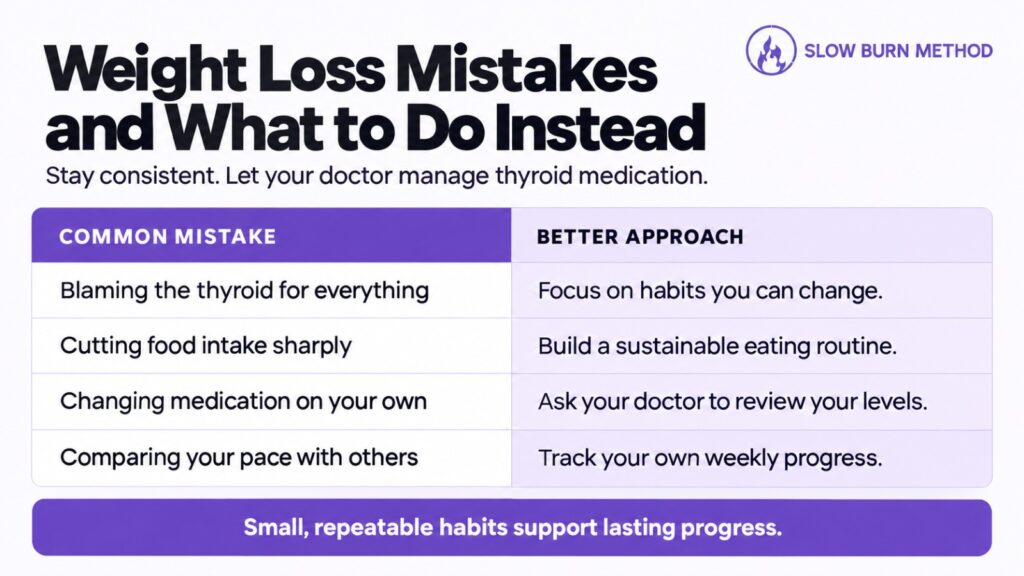
Four mistakes stall progress most often: blaming the thyroid for everything, cutting intake sharply, adjusting medication on your own and comparing your pace with others. When a relative says “thyroid hai, kya kar sakte ho,” it removes every habit you could still change, so it deserves a polite but firm no.
Cutting intake sharply feels productive for two weeks and then collapses into the hunger and regain that our students describe again and again. Medication is your doctor’s territory and if weight keeps climbing despite steady habits, the right move is to ask for your levels to be reviewed. Comparing yourself with a colleague who has no thyroid condition measures two different starting points against each other and at SBM, we’ve found that comparison makes people quit sooner than any plateau does. Pick the mistake you recognise most and start Step 1 today.
FAQs
Can you lose weight with hypothyroidism?
Yes. In a 2013 retrospective review of newly diagnosed patients, 52% lost weight within 24 months of starting levothyroxine, which means almost half did not lose weight from treatment alone. Your doctor manages the medication and your daily routine supplies the rest.
Will levothyroxine alone make me lose weight?
Levothyroxine alone usually brings modest weight loss and for some people none. A 2010 study of patients treated for hypothyroidism found that the weight lost came from excess body water, with fat mass virtually unchanged. Treat your medication as the baseline and let daily habits carry the rest of your progress.
How much protein should I eat per day?
ICMR-NIN’s 2020 recommended allowance for healthy Indian adults is 0.83 grams per kilogram of body weight per day, about 50 grams for a 60 kg adult. Spread it across your meals with dal, paneer, dahi, eggs or chana so that every plate carries some protein.
How long does it take to see progress?
Expect the first three months to be habit-building time, with your weekly average on the scale moving gradually. At SBM, we call a flat weekly average over three weeks a real plateau and only then do we adjust the plan. Progress that stays is worth the wait.
Can I increase my thyroid medication to lose weight faster?
No. Your doctor sets your dose through blood tests and the American Thyroid Association cautions that pushing thyroid hormone levels higher is unlikely to change weight significantly and may cause other metabolic problems. If your weight keeps climbing despite steady habits, ask your doctor to review your levels.
Conclusion
The fastest way to lose weight is to do it slowly, and a thyroid condition does not change that. Your doctor handles the medication, and you handle the four habits that sit on top of it: protein at every meal, a daily walk, a fixed bedtime and a weekly average. Twelve weeks is a fair window, because the weekly average needs that long to show a real trend. At your next meal, add one protein source such as dal, paneer or eggs to your plate. After all the months spent waiting for a tablet to do the whole job, what could twelve weeks of habits that you control add to your progress?
If you have tried before and want 20 weeks of structure around these habits, read how Take Control works and decide whether it fits where you are today. It was built for people in your position, so your next twelve weeks come with a plan.