

To lose weight with PCOS, build slow and steady habits around protein at every meal, regular mealtimes, strength training, daily walking, and good sleep, alongside care from your doctor. It usually takes longer than it does for women without PCOS because PCOS is closely linked with insulin resistance. A modest drop in body weight, often cited as 5 to 10%, is associated with improvements in PCOS symptoms according to the evidence summarised in the 2023 international PCOS guideline by Teede et al., which is why we never chase an aggressive plan.
- PCOS is closely linked with insulin resistance, which is why standard “eat less, do more” advice often gives slow or short-lived results.
- A modest drop in body weight is associated with better PCOS outcomes, and the 2023 guideline places habit-based care first for everyone with PCOS.
- At SBM, we start with protein at every meal, slower-digesting carbohydrates, strength training, daily walking, and steady sleep.
- Progress with PCOS is slow because of how the body works, so a slow scale is information and never a verdict on your effort.
Most PCOS advice online was written for women who weigh their food, follow a fixed workout split, and eat dinner at seven. Indian life looks different. You may be managing a joint family kitchen, a long commute, and an aunty who thinks one more roti is love. If you have PCOS or PCOD and you have been told to just lose weight and your symptoms will settle, you have probably already tried cutting calories, cutting carbohydrates, or adding extra cardio.
The weight moved for a while and then came back, and somewhere along the way the problem got described as a lack of discipline. That description is wrong, and in this article I will show you why losing weight is harder with PCOS and which habits we build first at SBM. One note before we begin: PCOS is a hormonal and metabolic condition that needs medical oversight. We are coaches and not doctors, so please work with a gynaecologist or endocrinologist alongside everything here.
1. Why PCOS and PCOD Make Weight Loss Harder: The Insulin Resistance Link
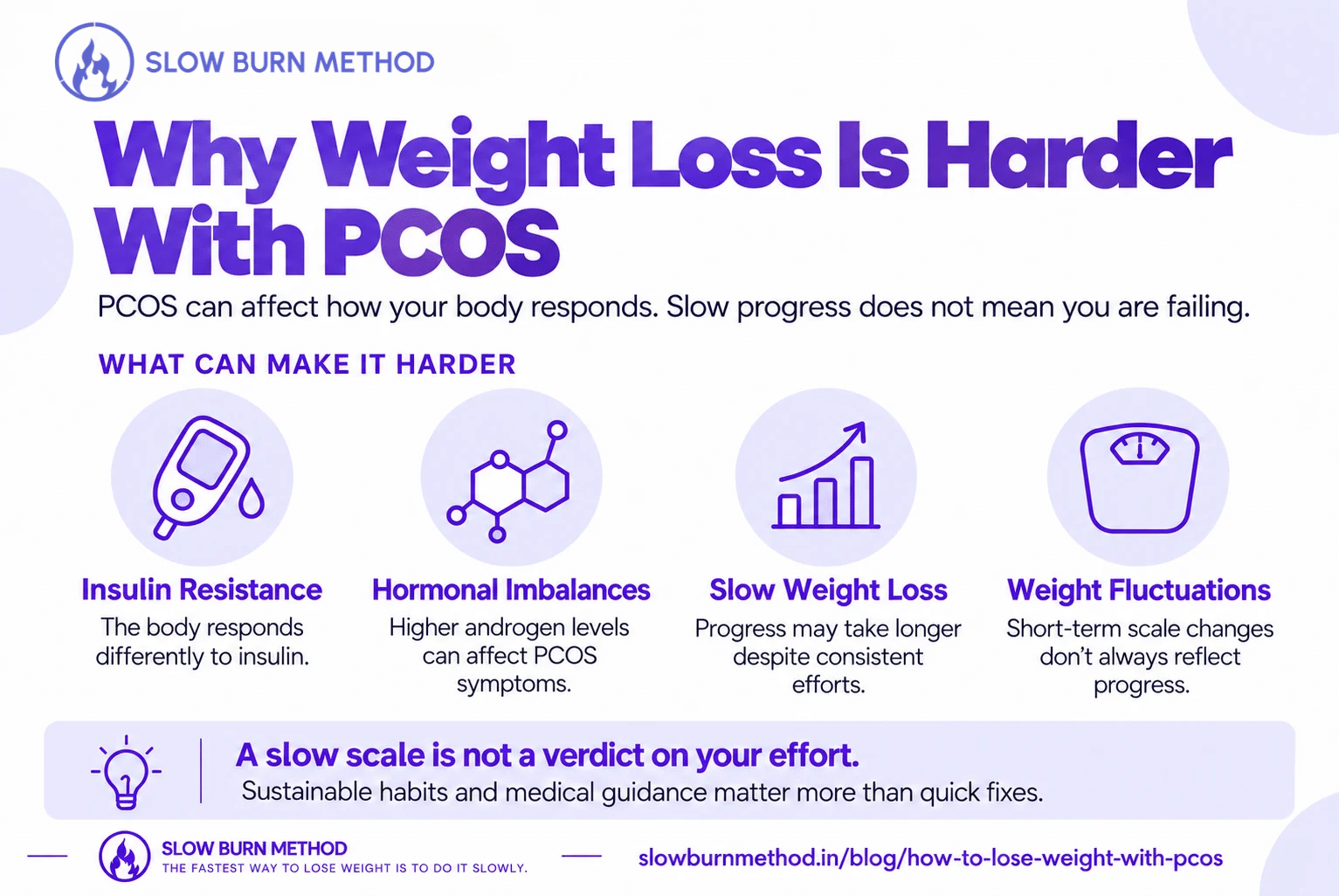
PCOS makes weight loss harder mainly because of its close link with insulin resistance, which changes how your body handles food. A review of PCOS in India by Ganie et al. (2019) reports that insulin resistance is consistently found in women with PCOS, although it is not part of the diagnostic criteria. The same review puts the prevalence of PCOS in India between about 4% and 22%, depending on the population studied and the criteria used, so you are far from alone.
In insulin resistance, the body’s cells respond less well to insulin, and the pancreas compensates by releasing more of it. Doctors commonly describe higher insulin levels as one reason fat is stored more easily around the abdomen and androgen levels rise, which feeds the irregular cycles and acne many women with PCOS know well. Stated differently, a woman with PCOS can eat carefully and move regularly and still see the scale respond slowly, because her body is working in a different internal environment. In India the terms PCOD and PCOS are often used interchangeably, and your doctor can tell you which applies to you. Stop reading a slow scale as a verdict on your effort.
2. Why Standard Weight Loss Advice Often Fails With PCOS
Standard advice such as eat less, do more cardio, and cut carbohydrates often fails with PCOS because it aims at the number on the scale and ignores how your body is responding to the plan. At SBM, we have found that very low food intake builds hunger and fatigue faster than a busy routine can absorb, so the plan usually collapses at the first wedding, festival, or deadline. When it collapses, the weight tends to return, and each round of loss and regain wears down the confidence you need to try again.
I want to be careful here. Research on whether very low intake specifically worsens PCOS hormones is limited, so I am describing what we see in coaching and not claiming a proven mechanism. What I can say plainly is that a plan which leaves you hungry and exhausted by four in the afternoon is a plan you cannot repeat for six months. If your current plan does that, change the plan.
3. How to Lose Weight With PCOS: Why Slow and Steady Is the Evidence-Backed Route
Slow and steady is the right route for PCOS because the 2023 international guideline puts habit-based care first for everyone with PCOS, and a modest drop in body weight is associated with improvements in insulin resistance, androgen levels, and central body fat. The guideline also rates the overall quality of its evidence as low to moderate, and it does not name one eating pattern as the best for PCOS. That is why I will not tell you a single magic food plan exists.
At SBM, we pair that evidence with what we see in practice, which is that a pace your routine can absorb is the only pace that holds. You can read more about the thinking behind this slow approach on the About Us page. Progress with PCOS also shows up in places the scale misses, such as steadier energy, fewer evening cravings, better sleep, and getting stronger in your workouts. Stated differently, the scale is one measure among several, and during the first weeks it is often the slowest to move. Choose three of those markers this month, write them down, and check them every Sunday alongside the scale.
4. A Step-by-Step Way to Eat and Move for PCOS Weight Loss
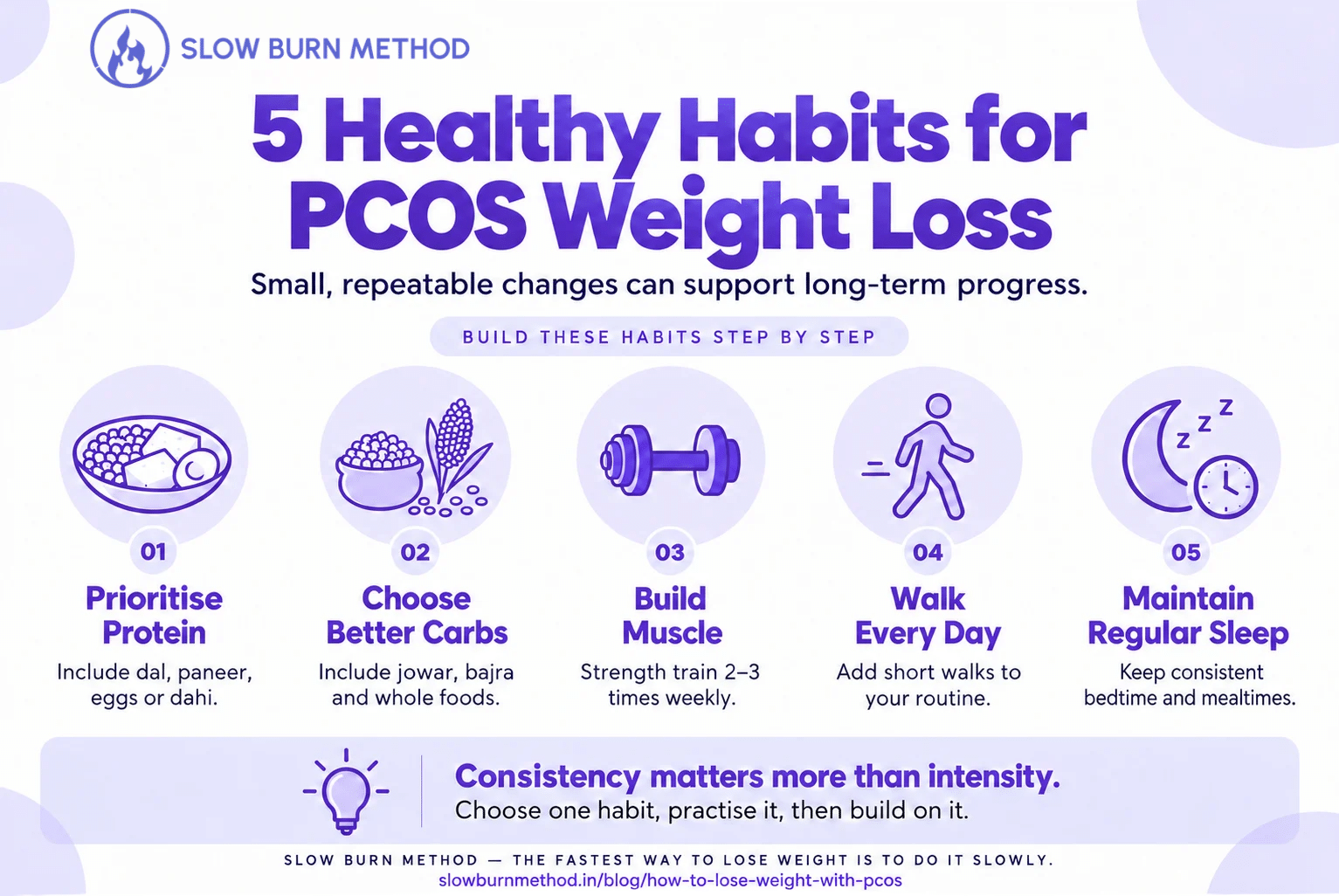
These five steps are the order in which we build habits at SBM for women with PCOS and PCOD. They are our coaching approach, and they sit inside the guideline’s message that no single eating pattern has been proven best.
Step 1: Put protein in every meal. At SBM, we find that most Indian meals are protein-light, so this is usually the highest-leverage change. Think dal with paneer and dahi at breakfast, rajma or chana with sabzi, or eggs if you eat them. Protein keeps you full for longer, which makes the gap between meals easier to hold.
Step 2: Keep carbohydrates and choose slower-digesting ones. Jowar or bajra roti, dal, vegetables, and smaller portions of rice digest more slowly than maida and biscuits, so your energy stays steadier. You do not need to remove dal and roti. The biscuits with chai three times a day are usually the first thing to adjust.
Step 3: Add strength training two to three times a week. Muscle uses glucose as fuel, so building it supports the way your body handles blood sugar. Bodyweight squats, lunges, resistance bands, or gym lifting all count, and consistency matters more than the format. Check with your doctor before starting if you have any medical concern.
Step 4: Walk every day. Daily walking is gentle enough to repeat on a tired day, and a walk after a meal fits easily into an Indian evening. Attach it to something you already do, such as the phone call after lunch.
Step 5: Protect your sleep and your mealtimes. At SBM, we find that irregular sleep and long gaps between meals make evening cravings much harder to handle. Fix a regular dinner time and a regular bedtime for the next two weeks before you change anything else.
“If you have PCOS or PCOD and the standard advice has not given you results that hold, you do not need a stricter version of it. If you are just starting out with protein, walking, and sleep, our BETTER programme builds these core habits one at a time in a group. If you have tried and stopped before and want structure around long-term habit change, Take Control was designed exactly for this.”
5. Why Doing More Cardio Can Slow Your Progress With PCOS
Adding more cardio when the scale stalls often backfires because it adds fatigue and hunger to a body already under strain, and the plan becomes impossible to repeat. The instinct to do more is understandable, since it feels like effort should always produce results. At SBM, the women with PCOS who make steady progress are rarely the ones exercising the most. They are usually doing two to three strength sessions a week, walking daily, and recovering properly between sessions. If you are about to add a fourth cardio session, add a rest day and a protein-rich meal instead.
6. Common PCOS Weight Loss Mistakes and Why They Backfire
The most common mistakes come from doing too much too soon, and every one of them is a reasonable response to feeling stuck.
Very low food intake. Cutting meals to almost nothing feels like commitment in week one. By week three the hunger and fatigue usually win, and the weight tends to return. Eat three steady meals with protein and give your routine time to settle.
Removing all carbohydrates for good. Reducing biscuits, maida, and sugary drinks is useful, and removing dal, vegetables, and millets as well is hard to sustain in Indian kitchens. Keep the whole-food carbohydrates and adjust the types.
Using body weight as the only measure. Energy, cravings, sleep, and strength often improve before the scale moves. At SBM, we count a flat weekly average over three weeks as a real plateau and anything shorter as ordinary fluctuation, so give any habit three to four weeks before you judge it.
Eating less when progress slows. The first questions at a plateau are about sleep, stress, and protein. Check those three before you cut anything.
Frequently Asked Questions
Can I lose weight with PCOS without medication?
Many women make real progress through habit changes alone, and the 2023 international guideline places habit-based care first for everyone with PCOS. Some women also need medication, and only your doctor can decide that. Build the habits in this article while you stay in regular touch with your gynaecologist or endocrinologist.
What should I eat with PCOD to lose weight?
No single eating pattern has been proven best for PCOS. At SBM, we build each meal around protein such as dal, paneer, dahi, eggs, rajma, or chana, add vegetables, and choose slower-digesting carbohydrates like jowar or bajra roti. Keep regular mealtimes and reduce biscuits, maida, and sugary drinks first.
How much weight do I need to lose to improve PCOS symptoms?
Evidence summarised in the 2023 international guideline links a modest drop in body weight, often cited as 5 to 10%, with improvements in insulin resistance and androgen levels. You do not need dramatic change. Your doctor can tell you what is right for your body, and cycle regularity is worth tracking too.
Why am I not losing weight with PCOS even when I eat very little?
Eating very little tends to be hard to sustain, and hunger and fatigue usually win within weeks. At SBM, we find that steady meals with protein, regular sleep, and consistent strength training work better than eating less. If nothing shifts despite real effort, ask your doctor about your hormonal markers.
Is strength training or cardio better for PCOS weight loss?
The 2023 guideline does not name one best exercise, and at SBM we start with strength training two to three times a week plus daily walking. Muscle uses glucose as fuel, and the plan is easier to repeat than daily intense cardio. Add more only when this feels easy.
How long does it take to see progress with PCOS?
Give each habit three to four weeks before you judge it, and compare weekly averages instead of daily scale readings. Energy, cravings, and sleep often improve before the scale moves. Cycles can take longer to respond, so discuss timelines with your doctor and keep the habits steady.