

you can lose weight without a workout routine, because weight loss depends on taking in fewer calories than your body uses, and food, sleep, and daily movement are all things you can change without a gym. The most reliable starting points are a protein anchor at every meal, slower eating, fewer packaged snacks, and enough sleep. Exercise still supports your health, and you can add it later once these habits feel steady.
- You can lose weight without structured exercise by changing how much and how fast you eat, because weight loss follows the gap between calories eaten and calories used.
- Protein-anchored meals, slower eating, fewer ultra-processed snacks, and enough sleep each have research linking them to how much people eat.
- Daily movement, such as walking after meals, adds to the calories you use without needing a workout slot.
- At SBM, we build these into habits you can repeat for months, because a change you cannot repeat will not last.
Most advice on how to lose weight without exercise assumes you have a free hour, a quiet park, and a family that respects your plans. Indian life rarely works like that. You may leave home at seven, return after a long commute, eat dinner at nine thirty, and find another roti on your plate before you have said no. If you have tried to fit a workout into that schedule and failed, the schedule was the problem, and you were never short on character.
A large share of weight loss is decided at the plate, and the plate is something you control in every home, hostel, and office canteen. Here are the changes we use at SBM: building each meal around protein, eating more slowly, reducing packaged snacks, protecting your sleep, moving through the day, and giving each change enough time. You will finish this article knowing what to change first this week and why it works. I will also tell you where the research is strong and where it is limited.
1. How to Lose Weight Without Exercise Starts With Your Plate
You can lose weight without exercise because weight loss depends on eating fewer calories than your body uses, and food is the side of that equation you control most directly. An extra spoon of ghee on your roti, a second helping of rice at dinner, and a biscuit with every cup of chai add up over a week without anyone noticing. Stated differently, the small additions you stopped seeing years ago are usually where the gap lives. Exercise does raise the calories you use, but it is also the part that busy people struggle most to repeat week after week, which is why we start with food at SBM. Write down everything you ate yesterday, including chai, snacks, and second servings, and circle the two meals where you ate most automatically.
2. Build a Protein Anchor Into Every Meal
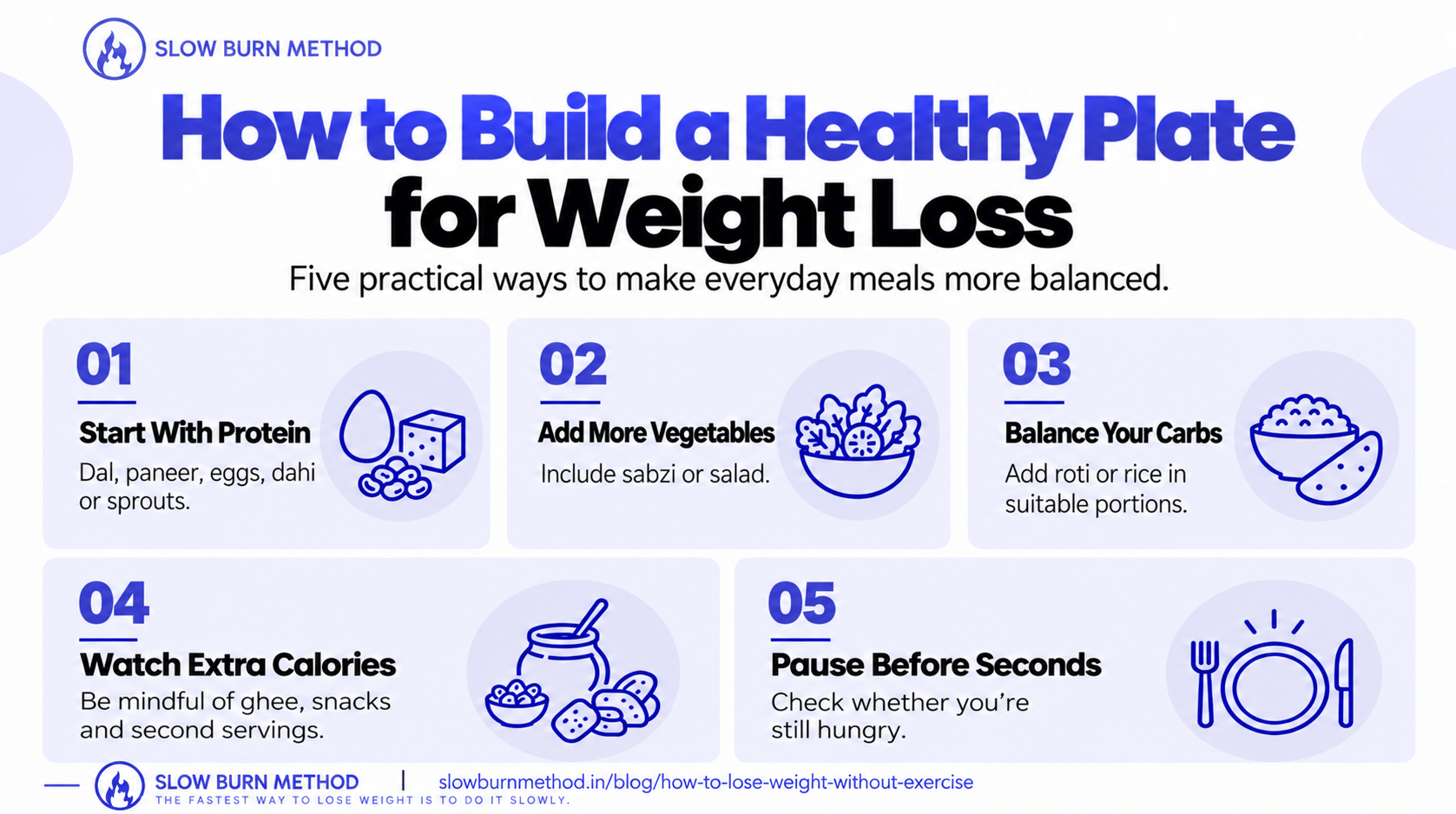
A protein anchor is a protein-rich food at the centre of each meal, such as dal, paneer, eggs, dahi, or sprouts, and it helps you stay full for longer. A review by Leidy et al. (2015) found that higher-protein meals raise fullness modestly, and it suggested about 1.2 to 1.6 grams of protein per kilogram of body weight per day, with roughly 25 to 30 grams per meal, for people losing weight. For someone who weighs 70 kg, that works out to 84 to 112 grams a day. The same review found long-term results were mixed, largely because people struggled to keep the higher intake going, so at SBM we keep the habit simple. Follow these steps at your next meal:
Step 1: Choose the protein first. Decide whether the plate is built around dal, paneer, eggs, dahi, or sprouts before you decide anything else.
Step 2: Add the vegetables. Fill a good part of the plate with sabzi or salad.
Step 3: Fit the grain around it. Add roti or rice in the space that remains, and serve it after the first two.
Pick the protein for tomorrow’s lunch tonight.
3. Eat Slower and You Will Usually Eat Less
Eating more slowly usually lowers how much you eat in a single meal. Robinson et al. (2014) pooled 22 experiments and found that slower eating was linked with lower calorie intake whichever method was used to slow people down, although the studies varied a lot in design. Most of us eat fast because the day is crowded, and a fast eater can finish a plate before fullness has had time to show up. Stated differently, speed lets the food arrive before the feeling does. Use these steps:
Step 1: Sit down for the first serving. Keep the phone away from the table.
Step 2: Put the spoon or roti down between bites. Pick it up again once you have swallowed.
Step 3: Pause before a second serving. Ask yourself whether you are still hungry.
Take the first five bites at your next meal at half your usual speed.
4. Swap Packaged Snacks for Home Food Before You Cut Any Roti
Replacing packaged snacks with home-prepared food is one of the quickest ways to lower your intake, because ultra-processed food is easy to eat fast and in large amounts. In a four-week trial by Hall et al. (2019), 20 adults ate meals matched for calories, sugar, fat, and fibre. When the meals were ultra-processed, they ate about 500 more calories a day and gained weight, while they lost weight on minimally processed meals. The study was small, and the authors said they could not tell which feature of the food drove the difference. In Indian homes this usually means biscuits with chai, packets of namkeen, instant noodles, and bottled juice. At SBM, we ask people to change one item at a time, because removing everything at once rarely survives the first busy week. Replace one packaged snack you eat daily with a home option, such as roasted chana with your evening chai.
“If you have started and stopped changes like these before, the gap was never information. If you are just starting out with protein, sleep, and walking, our BETTER programme builds these habits one at a time in a group. If you want structure around building these habits one week at a time, Take Control was designed exactly for this.”
5. Protect Your Sleep Because a Tired Body Eats More
Short sleep tends to increase how much you eat the next day. In a pooled analysis of 11 studies with 172 people, Al Khatib et al. (2016) found that people who slept less ate about 385 more calories, with no matching rise in the calories they used. Those studies ran from one day to two weeks, so they show a clear pattern and stop short of proving a long-term effect. In Indian routines, sleep usually gets squeezed by late dinners, long commutes, and a phone in bed. At SBM, we count sleep as part of your eating habits, because the late-night snack is often a sleep problem in disguise. Move your bedtime fifteen minutes earlier this week and hold it for seven days.
6. How to Lose Weight Without Exercise and Still Move More Through the Day
You can move more without exercising by attaching small bursts of walking to things you already do. Movement adds to the calories your body uses, so it supports the same equation as your plate, and it needs no gym, no kit, and no special time slot. A ten-minute walk after lunch, the stairs instead of the lift, pacing during phone calls, and walking to the market all count. At SBM, we treat this as an ordinary part of the day, and people find it easier to repeat because nobody has to feel like an athlete to do it. Choose one routine you already have, such as the phone call after lunch, and walk through it this week.
7. Why Most Attempts at Losing Weight Without Exercise Stall by Week Three
Most attempts stall because people change everything at once and judge the result too early. Skipping meals, cutting rotis to almost nothing, and pushing through on willpower all look like commitment in week one and collapse by week three, usually when a wedding, a festival, or a deadline arrives. Willpower is the wrong tool here because a busy day uses it up, whereas a habit that already sits inside your routine needs very little of it. Give each change three to four weeks before you judge it, and compare weekly averages instead of daily scale readings. At SBM, we count a flat weekly average over three weeks as a real plateau, and anything shorter as ordinary fluctuation.
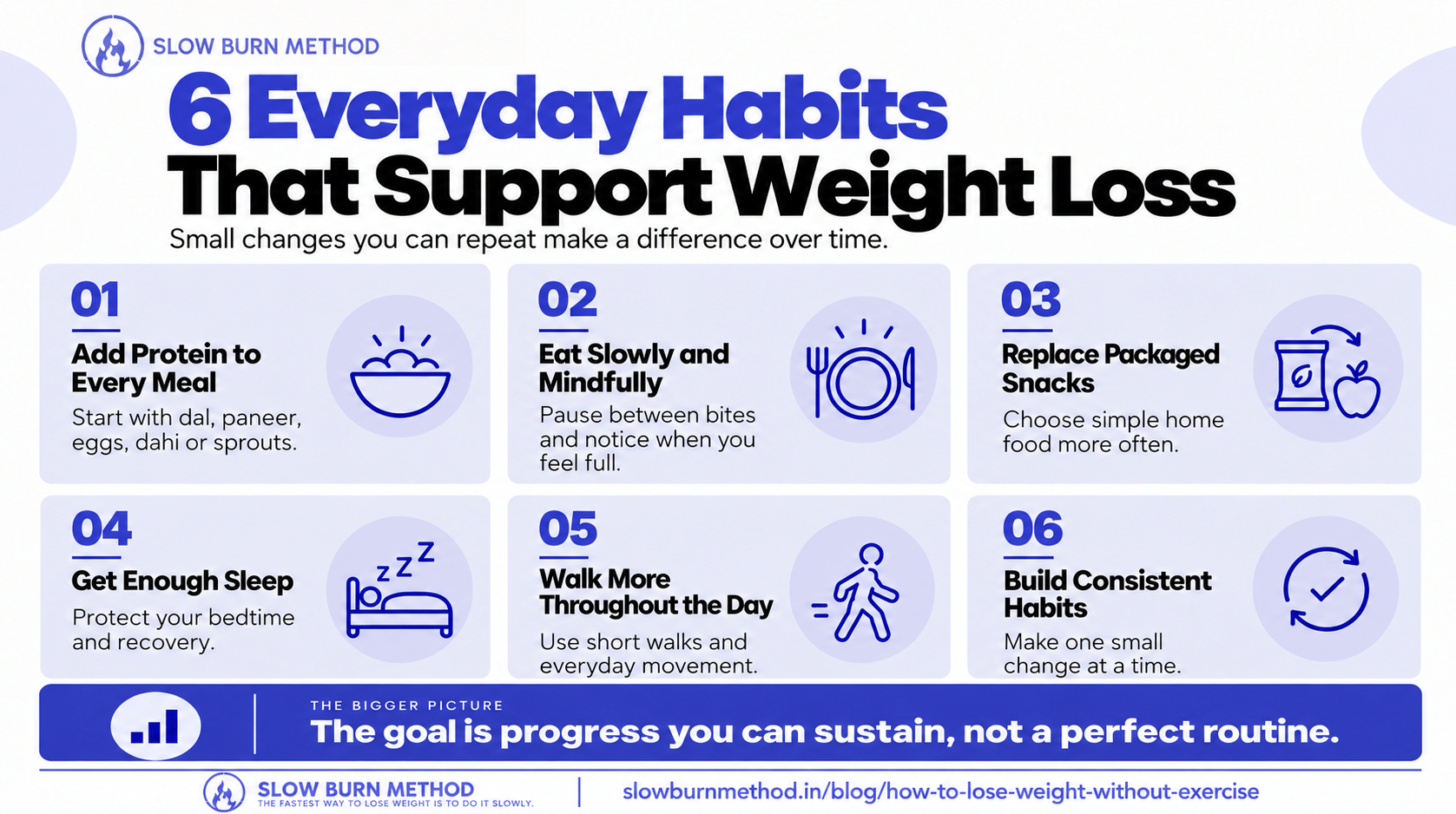
On pace, CDC guidance says that losing about 1 to 2 pounds, or roughly 0.5 to 1 kg, a week is associated with keeping weight off. A randomised trial by Purcell et al. (2014) in adults with excess weight found that those who lost weight quickly regained a similar share as those who lost it gradually. Stated differently, speed matters less than whether you can still hold the routine a year from now, which is why we coach slow. Add one habit at a time, and add the next only when the first needs no thinking.
Frequently Asked Questions
How long does it take to lose weight without exercise?
Expect three to four weeks before you can judge whether a change is working, and judge it by a weekly average instead of daily scale readings. CDC guidance points to about 1 to 2 pounds, or roughly 0.5 to 1 kg, a week as a steady pace. At SBM, we call three flat weeks a real plateau.
How much protein do I need a day to lose weight?
A review by Leidy and colleagues (2015) suggests 1.2 to 1.6 grams of protein per kilogram of body weight per day, with about 25 to 30 grams per meal. For a 70 kg adult, that is roughly 84 to 112 grams daily. Spread it across dal, paneer, eggs, dahi, and sprouts through the day.
Which Indian foods keep me full for longer?
Protein-rich foods such as dal, paneer, eggs, dahi, and sprouts give the most lasting fullness, since research reviewed by Leidy (2015) shows protein raises fullness modestly. Sabzi adds volume to the plate. Build each meal around one protein first, then add vegetables and your roti or rice. At SBM, every plate starts this way.
Should I skip dinner to lose weight?
At SBM, we advise against it. A skipped dinner tends to turn into an oversized late-night snack and makes the next day harder. Eat an earlier dinner built around protein and sabzi, with a modest portion of roti or rice, and give your kitchen a closing time.
Is it okay to lose weight without exercise?
For most healthy adults, changing food, sleep, and daily walking is a reasonable way to begin, and exercise can be added later for muscle, heart, and mood. We are coaches and not doctors, so if you have a medical condition or take regular medication, speak to your doctor before changing how you eat.
Does poor sleep make weight loss harder?
Yes. A pooled analysis by Al Khatib and colleagues (2016) found that people who slept less ate about 385 more calories, with no matching change in energy used. The studies were short, so treat it as a strong pattern. Protect your bedtime, and your evening snacking becomes easier to manage.